Fujitsu Mini Split Error Codes and Indicator Lamps
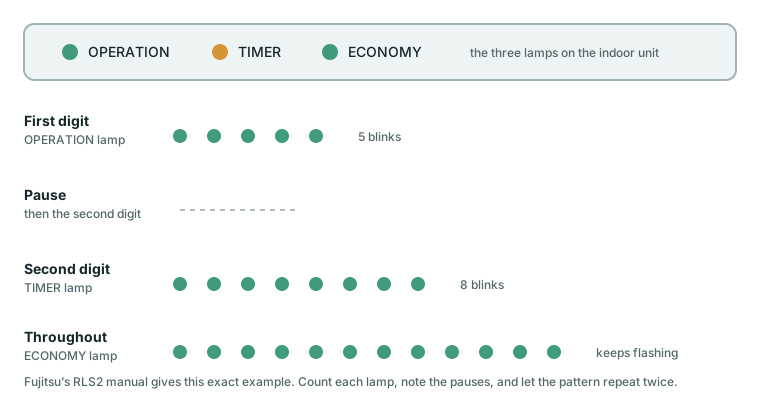
Fujitsu does not publish one error-code list, and that is a deliberate position rather than an oversight. Fujitsu General's own support documentation states it plainly: "The same LED count or code can represent a different fault on another model. Use only the table that specifically lists the equipment being tested." The code-to-fault table lives in the model-specific Service Instruction for your indoor and outdoor pair, which Fujitsu distributes through its dealer portal. What is published, and what this page covers, is how to get the code off your unit: on older RLS2 and RLF-era units the OPERATION lamp blinks the first digit and the TIMER lamp blinks the second, while the ECONOMY lamp flashes continuously to say you are in error mode. On current LMAS, LPAS and LZBS units the code is read through Service check mode on the remote. Get the code and the model number, then match them against the right document — not against a list from a search result.
How does a Fujitsu mini split show an error code?
Two ways, and which one applies depends on the generation of your indoor unit rather than on anything you can choose. Older wall units count the code out on their indicator lamps; current units display it through a service mode on the remote. Both give you a two-character code, and neither prints its meaning anywhere on the machine — that part lives in a document Fujitsu supplies to dealers.
On older RLS2 and RLF-era wall units, the code is counted off the indicator lamps. Fujitsu's RLS2 operating manual (PART No. 9319356051) gives a worked example, using the case of an intake grille that has not been fully closed: "the Operation Lamp will flash 5 times, and then the Timer Lamp will flash 8 times, and this will be repeated. The Economy Lamp will continue to flash." So OPERATION carries the first digit, TIMER carries the second, and ECONOMY flashing is the marker that you are looking at an error at all rather than at normal operation.
On current LMAS, LPAS and LZBS units, the remote does the work. The US operation manuals describe Service check mode: "Press and hold for more than 5 seconds. The remote controller will enter to the Service check mode." Then, stepping through the codes, "The indoor unit emits 1 short beep each time the error code changes. When the corresponding error code is shown, the indoor unit emits multiple beeps and all the indicator lamps on the indoor unit blink." Fujitsu's instruction for what to do with the result is unambiguous: "Tell the error code to authorized service personnel when consulting them."
Reading the lamps: normal states first
Before counting blinks, make sure you are looking at a fault at all. Three of the four lamp behaviours below are the unit working correctly, and defrost in particular gets reported as a breakdown every winter.
| Lamp | Color | What it means | Fault? |
|---|---|---|---|
| OPERATION | Green | Normal operation | no |
| OPERATION, flashing slowly | Green | Automatic defrost in progress | no |
| TIMER | Orange | Timer operation active | no |
| ECONOMY | Green | Economy operation (MIN. HEAT on RLS2) | no |
| Filter indicator, 3 blinks at 21-second intervals | — | Clean the air filter, then reset the filter sign | no |
| OPERATION and TIMER blinking with ECONOMY flashing fast | — | Stored fault — stop and consult service | yes |
That last row is the signature to remember. Fujitsu's operation manuals instruct owners to "Immediately stop operation and turn off the electrical breaker" and consult authorized service personnel when the OPERATION and TIMER lamps flash while ECONOMY flashes fast — the same instruction the manuals give for a burning smell or smoke, or for water leaking from the unit.
How to enter error memory mode
Fujitsu General's official support documentation gives two routes into the stored-error display on high-wall split systems. The first is the recessed TEST RUN button under the remote's cover, pressed with a non-metallic point. The second is on the unit itself: press and hold the MANUAL AUTO button behind the indoor unit's front panel for 10 seconds or more. The access window after power-up is roughly 2 minutes 20 seconds, so if nothing happens, power-cycle and try again promptly.
Counting the blinks is the part people rush. Fujitsu's guidance is to count the flashes of each lamp, note any pauses, and let the pattern repeat at least twice before writing anything down. A miscount by one is a different fault entirely.
What you can fix, and what you cannot
Fujitsu's operation manuals draw this line themselves, which makes it unusually clean. Four conditions are documented as owner-actionable, and they are worth working through before calling anyone.
- Dirty air filter. Clean it, refit it, and reset the filter sign. The filter indicator's own pattern — three blinks at 21-second intervals — is a maintenance reminder, not a fault.
- Blocked intake or outlet. Fujitsu's instruction: "Remove the obstructions." Furniture, curtains and seasonal clutter in front of a wall unit are the usual culprits.
- Defrost, mistaken for a fault. Fujitsu documents the OPERATION lamp flashing slowly during automatic defrosting, and the AIRSTAGE troubleshooting FAQ adds that "The unit will temporarily stop operating (between 7 and 15 minutes) as the Automatic Defrosting mode operates." Wait it out — the manual's own instruction is to wait a maximum of 15 minutes.
- The three-minute restart delay. The FAQ: "If the unit is stopped and then immediately started again, the compressor will not operate for about 3 minutes," and "Whenever power is interrupted, the protection circuit will prevent the unit from re-start for 3 minutes." Not a fault.
- Anything else. Fujitsu: if "the problem persists even if you perform these checks or diagnostics," it goes to authorized service personnel.
The stop-immediately list is short and absolute: a smell of burning or visible smoke, water leaking from the unit, or the OPERATION-plus-TIMER-with-fast-ECONOMY signature. In each case Fujitsu says to turn off the electrical breaker before calling.
Why we are not printing a code table
Because we cannot verify one against Fujitsu's own US documentation, and publishing an unverified table would be worse than publishing nothing. Fujitsu does not put the code list in the consumer operation manuals. It publishes it in model-specific Service Instruction documents — for example the Service Instructions for the ASU18/24RLF with AOU18/24RLXFW1, for the AOU48RLXFZ1, and for the ASU24CL1 with AOU24CL1 — distributed through Fujitsu's dealer portal, which is not open to the public.
There are code tables circulating that come from Fujitsu General documents for other markets, covering GENERAL-branded constant-speed models sold outside North America. They are real documents and they are also the wrong documents. Fujitsu's own warning covers exactly this case: "Button locations, lamp names and display behaviour can vary between indoor-unit series," and the same LED count can mean a different fault on another model.
If you need the meaning of a specific code, the reliable routes are your installing dealer, Fujitsu's authorized service network, or the Service Instruction for your exact indoor and outdoor model pair. We would rather send you there than guess.
What else the manuals say is normal
The AIRSTAGE troubleshooting FAQ documents a long list of behaviours that generate service calls and should not. Water flowing sounds during operation and shortly after shutdown; noise "particularly noticeable for about 2-3 minutes after starting operation (sound of coolant flowing)"; a slight squeaking from expansion and contraction of the front cover; sizzling during defrost in heating; steam rising from the outdoor unit while defrosting; low fan speed at the start of heating, during dry operation, and in Super Quiet mode; and the outdoor unit stopping in heating once the room rises above the thermostat setting. Room odours absorbed and re-emitted are on the list too.
None of these produce an error code, and none of them need a technician.
Repair or replace?
The four owner-actionable items above cost nothing and resolve a real share of complaints — a filter and a clear intake are not trivial on a system that moves this much air. Beyond them, a Fujitsu mini split is a sealed refrigerant system with an inverter-driven compressor, and every fault that produces a stored code is dealer work. Opening the refrigerant circuit requires EPA Section 608 certification, and these systems carry long compressor warranties that field tampering will end.
The practical advice is unglamorous: get the code, get both model numbers off the data plates, and hand all three to the dealer. A technician arriving with the code already known usually diagnoses in one visit rather than two.
When to call for service
- OPERATION and TIMER lamps blinking with ECONOMY flashing fast — Fujitsu says turn off the breaker first.
- Any smell of burning, visible smoke, or water leaking from the indoor unit.
- A stored code that persists after cleaning the filter and clearing the intake.
- Ice on the outdoor coil that does not clear after a full 15-minute defrost cycle.
- Any work inside either unit — sealed refrigerant system, and dealer-warranty territory.
Parts and supplies mentioned on this page
A filter brush and coil cleaner cover the two maintenance items Fujitsu actually asks owners to perform; everything past that is a service call.
- Washable mini split filter cleaning brushCheck price on Amazon
- Mini split condenser coil cleanerCheck price on Amazon
Related pages
Mitsubishi encodes faults as a blink count on a single lamp, and the meaning of a given count changes between series — the same trap in a different shape: Mitsubishi mini split remote symbols and lamp codes.
Sizing an AC for the room?Air Conditioner BTU Calculator The ENERGY STAR sizing table with its sun, people, and kitchen adjustments.