Goodman Furnace 9H: Gas Heat Status, Not an Error
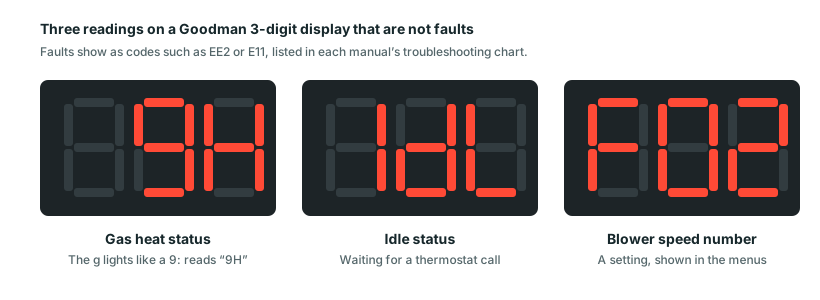
9H is not a fault code. It is gH, the gas-heat status, as it looks on a Goodman furnace's seven-segment display. Goodman's *M9S96 and *M9C96 manuals list gH as "Gas heat - Single Stage Control" (IOG-2029A p. 42; IOG-2027B p. 44), and the display font lights the same segments for the letter g as for a 9. A furnace showing 9H is telling you it is in gas-heat mode. On the *MVC80 the same status comes in two stages, gH1 and gH2, which read as 9H1 and 9H2.
| Code | 9H (Gas heat - Single Stage Control) |
|---|---|
| Applies to | Goodman display furnaces *M9S96 / *C9S96 / *M9S92 and *M9C96 / *C9C96 (gH, drawn as 9H), *MVC80 / *CVC80 (gH1, gH2) and *M9S80*U (gH) |
| Severity | Not a fault |
| DIY | No action needed |
| Last checked |
What Goodman's manuals say gH means
Each Goodman display furnace lists its normal operating states in a status table, and gas heat is one of them. The wording differs slightly by series and, on the *M9C96, by revision. None of these tables puts gH among the faults.
| Series | As printed | Goodman's wording (verbatim) | Manual, page |
|---|---|---|---|
| *M9S96 / *C9S96 / *M9S92 | gH | Gas heat - Single Stage Control | IOG-2029A (02/2022), p. 42 |
| *M9C96 / *C9C96 | gH | Gas heat - Single Stage Control | IOG-2027B (02/2022), p. 44 |
| *M9C96 / *C9C96 (earlier revision) | gH1, gH2 | Gas heat, Low Stage; Gas heat, High Stage | IOG-2027A (08/2021), p. 44 |
| *MVC80 / *CVC80 | gH1, gH2 | Gas Heat, Low Stage; Gas Heat, High Stage | IOG-2023A (05/2020), p. 32 |
| *M9S80*U | gH | Gas Heat | IOG-2031A (04/2022), p. 19; "g H" on the wiring-diagram table, p. 32 |
The *M9C96 entry changed between revisions. IOG-2027A listed two-stage gas heat as gH1 and gH2; IOG-2027B, the current revision, prints a single gH under a "2 STAGE STATUS CODES" heading. If your *M9C96 shows 9H1 or 9H2, it is reporting low or high stage gas heat in the earlier scheme.
Why it reads as 9H
Seven-segment displays build every character from the same seven bars, and a lowercase g uses exactly the bars of a 9. Goodman's manuals print these codes in a display-style font, and on the rendered pages of IOG-2029A (p. 42), IOG-2027B (p. 44) and IOG-2023A (p. 32) the g in gH is drawn the same way as a 9, so the code reads "9H", "9H1" or "9H2".
The *M9S80*U manual is the exception in print: its status menu on p. 19 sets "gH" in ordinary type, and the wiring-diagram table on p. 32 spells it "g H" one segment at a time. What the control's display lights is the same seven-bar shape either way.
The other normal status codes on these furnaces
The status tables list everything the display shows while the furnace is working normally. If you see one of these, the control is reporting what it is doing, not a fault. These are the tables for the two series that print 9H most directly, with the *MVC80 list below them.
| Display | Status shown (verbatim) | Page |
|---|---|---|
| IdL | Idle | 42 |
| FAn | Continous Fan | 42 |
| 1AC | Compressor Cooling, Low Stage | 42 |
| 2AC | Compressor Cooling, High Stage | 42 |
| gH | Gas heat - Single Stage Control | 42 |
| EOL | OEM test Mode | 42 |
| Display | Status shown (verbatim) | Page |
|---|---|---|
| IdL | Idle | 44 |
| FAn | Continous Fan | 44 |
| 1AC | Compressor Cooling, Low Stage | 44 |
| 2AC | Compressor Cooling, High Stage | 44 |
| gH | Gas heat - Single Stage Control | 44 |
| EOL | OEM test Mode | 44 |
The *MVC80 list is longer because the same control also reports heat pump, inverter and dehumidification modes:
| Display | Description of System Status (verbatim) | Page |
|---|---|---|
| 1AC | Compressor Cooling, Low Stage (non-communicating units) | 32 |
| 2AC | Compressor Cooling, High Stage (non-communicating units) | 32 |
| 1HP | Compressor Heat, Low Stage (non-communicating units) | 32 |
| 2HP | Compressor Heat, High Stage (non-communicating units) | 32 |
| AC | Compressor Cooling, Single-Stage (single stage non-comm. units) | 32 |
| AC1 | Compressor Cooling, Low Stage (communicating units) | 32 |
| AC2 | Compressor Cooling, High Stage (communicating units) | 32 |
| dF1 | Defrost, Low Stage Gas Heat | 32 |
| dF2 | Defrost, High Stage Gas Heat | 32 |
| dHU | Dehumidification | 32 |
| FAn | Constant Fan | 32 |
| gH1 | Gas Heat, Low Stage | 32 |
| gH2 | Gas Heat, High Stage | 32 |
| HP | Compressor Heat, Single-Stage (single stage non-comm. units) | 32 |
| HP1 | Compressor Heat, Low Stage (Communicating Units) | 32 |
| HP2 | Compressor Heat, High Stage (Communicating Units) | 32 |
| IdL | Idle | 32 |
| vAC | Inverter Cooling | 32 |
| vHP | Inverter Heating | 32 |
If the furnace isn't heating while it shows 9H
A gH or 9H reading says the control is in gas-heat mode, so if the house is cold the useful question is what else the control has recorded. Goodman's *MVC80 manual describes how a real fault looks: "The 7-segment LED displays will display an error code that may contain a letter and number." (IOG-2023A p. 30)
On the *M9S96, *M9C96, *MVC80 and *M9S80*U, fault codes in the troubleshooting chart are mostly EE followed by a character (EE0 to EE9, EEA and so on) or E1 followed by one (E10, E11), and each control keeps a short fault history (the L6F, "Last 6 Faults", menu on the *M9S96, *M9C96 and *M9S80*U). The full fault charts, with how to view and clear stored faults, are on the Goodman furnace codes hub; a pressure-switch code in particular has its own page, Goodman 3 flashes and EE2.
Two neighbouring readings on the same display are also normal: 1dL (IdL), the idle status, and F02, a blower speed number.
Goodman's safety wording
The gas-heat status means the burners are, or should be, lit. Goodman prints its gas-leak instruction on p. 3 of IOG-2029A, IOG-2027B and IOG-2031A and on p. 2 of IOG-2023A; it is given here verbatim with the carbon monoxide warning.
| Goodman's wording (verbatim) | Source |
|---|---|
| "WHAT TO DO IF YOU SMELL GAS: • Do not try to light any appliance. • Do not touch any electrical switch; do not use any phone in your building. • Immediately call your gas supplier from a neighbor’s phone. Follow the gas supplier’s instructions. • If you cannot reach your gas supplier, call the fire department." | IOG-2031A, p. 3 |
| "Possible property damage, personal injury or death due to fire, explosion, smoke, soot, condensation, electrical shock or carbon monoxide may result from improper installation, repair operation, or maintenance of this product." | IOG-2011U, p. 3 |
Frequently asked questions
What does 9H mean on a Goodman furnace?
It is gH, Goodman's gas-heat status code, as it looks on a seven-segment display. The *M9S96 and *M9C96 manuals list it as "Gas heat - Single Stage Control". It is a normal operating state, not an error.
What do 9H1 and 9H2 mean?
Low and high stage gas heat. They are gH1 and gH2 in the *MVC80 manual ("Gas Heat, Low Stage" and "Gas Heat, High Stage", IOG-2023A p. 32) and in the earlier *M9C96 manual, IOG-2027A.
My Goodman furnace shows 9H but the house is cold. What now?
The 9H reading itself says only that the control is in gas-heat mode. The control keeps a short history of recent faults, and any EE or E1 code in it can be matched to the chart for your series on the Goodman codes hub. Repairs beyond the filter are for a qualified servicer.
Is 9H the same on every Goodman furnace?
Only on the display furnaces. The single-LED and *MEC96 furnaces have no display, and the two-character *MVM96 and *MVM97 use a different list in which gas heat is shown as H followed by a percentage of demand.