Daikin U4: Signal Transmission Error Between Indoor and Outdoor Unit
U4 is Daikin's code for a signal transmission error between the indoor unit and the outdoor unit. Daikin's wording is precise about what the control actually did: it checks whether the signal transmission data from the outdoor unit is normal, and it posts U4 when "the data sent from the outdoor unit cannot be received normally, or the content of the data is abnormal." That is the indoor unit saying it has lost a usable conversation with the outdoor unit — which can mean the outdoor unit is not powered, that the link between them is broken, or that either board has failed. Daikin lists the same supposed causes on both families: reduction of power supply voltage, a wiring error, a break in the connecting wires between the units (specifically wire No. 3), a defective outdoor unit PCB, a short circuit inside the fan motor winding, a defective indoor unit PCB, and a disturbed power supply waveform. The multi-split manual adds "power supply voltage out of specification" for its ducted and cassette indoor units. Every item on that list is inside the equipment, so the honest homeowner scope here is small: confirm the code, confirm both units have power, and book the call.
| Code | U4 (Signal transmission error) |
|---|---|
| Applies to | FTX-N inverter pair (SiUS041638EA); 2MXS-N / 3MXS-R / 4MXS-R multi-split, RA and SA indoor units (SiUS121736EA) |
| Severity | Unit will not run |
| DIY | Check, then call — owner-level checks first, then a dealer |
| Last checked |
Which Daikin systems this applies to
U4 appears in both US service manuals GridComfort works from, with the same definition, so the meaning below is verified for these families and no others.
| Family | Where U4 is documented | Applied models |
|---|---|---|
| FTX-N wall-mounted inverter pair | SiUS041638EA §4.7, p. 68 | Indoor FTX30NVJU, FTX36NVJU; outdoor RK30NMVJU(A), RK36NMVJU(A) cooling only, or RX30NMVJU(A), RX36NMVJU(A) heat pump |
| Multi-split, RA indoor units | SiUS121736EA §5.6, p. 160 | CTXG, FTXR, CTXS, FTXS, CDXS, FDXS, FVXS heads on 2MXS18NMVJU(A), 3MXS24RMVJU(A), 4MXS36RMVJU(A) |
| Multi-split, SA indoor units | SiUS121736EA §6.9, p. 174 | FDMQ09/12/15/18/24RVJU and FFQ09/12/15/18Q2VJU heads on the same outdoor units |
If your Daikin is not in that list, U4 on your system is defined by your own service manual, not by this page. The letter-and-digit codes are broadly consistent across Daikin's residential range, but the applied families, the decision conditions and the retrieval procedure are documented per manual, and this page does not claim to speak for manuals it has not read.
Do not confuse U4 with its neighbours
Three codes in the same family sound alike and mean different things. Getting them mixed up is the difference between a communication problem between two boxes and a fault inside one of them.
| Code | Daikin's description | What is talking to what |
|---|---|---|
| U4 | Signal transmission error (between indoor unit and outdoor unit) | Indoor unit ↔ outdoor unit |
| U7 | Signal transmission error on outdoor unit PCB | Two microcontrollers on the outdoor board |
| U5 | Signal transmission error (between indoor unit and remote controller) | SA indoor unit ↔ its wired remote |
| U8 | Signal transmission error (between MAIN remote controller and SUB remote controller) | Two wired remotes |
| UA | Mismatching of indoor unit and outdoor unit | Wrong combination of units installed together |
UA is the one most often mistaken for U4 on a new installation, because both appear when a system has just been commissioned. UA means the two units should not be paired at all; U4 means the pairing is fine but the message is not arriving.
Making sure U4 is really the code
Daikin holds most codes until you request them, so the first job is confirming what the system is actually reporting rather than acting on a guess. Both manuals publish the same two methods.
- Method 1, Timer Cancel. Hold the remote's Timer Cancel button for five seconds.
00appears on the temperature display. Press Timer Cancel repeatedly; a short beep or two consecutive beeps mean the shown code does not match, and a long beep means it does. In both manuals' Method 1 sequences,U4sits near the start of the list. - Method 2, service check. If Method 1 never reaches your code — Daikin notes that not all codes appear there — press the centre of the Temp button and the Mode button together, select
5C, press Mode, and set the left then the right digit until you hear the long beep on each. On an ARC452-series remote, enter diagnosis mode by pressing Temp down, Temp up and Mode together instead. - Exit cleanly. Hold Timer Cancel five seconds, or leave the remote untouched for 60 seconds.
- On a multi-split, note which head reported it. The manual states that an indoor unit code can take precedence in the remote display, so on a three- or four-zone system the code you retrieve belongs to the head you retrieved it from.
What an owner can check without opening anything
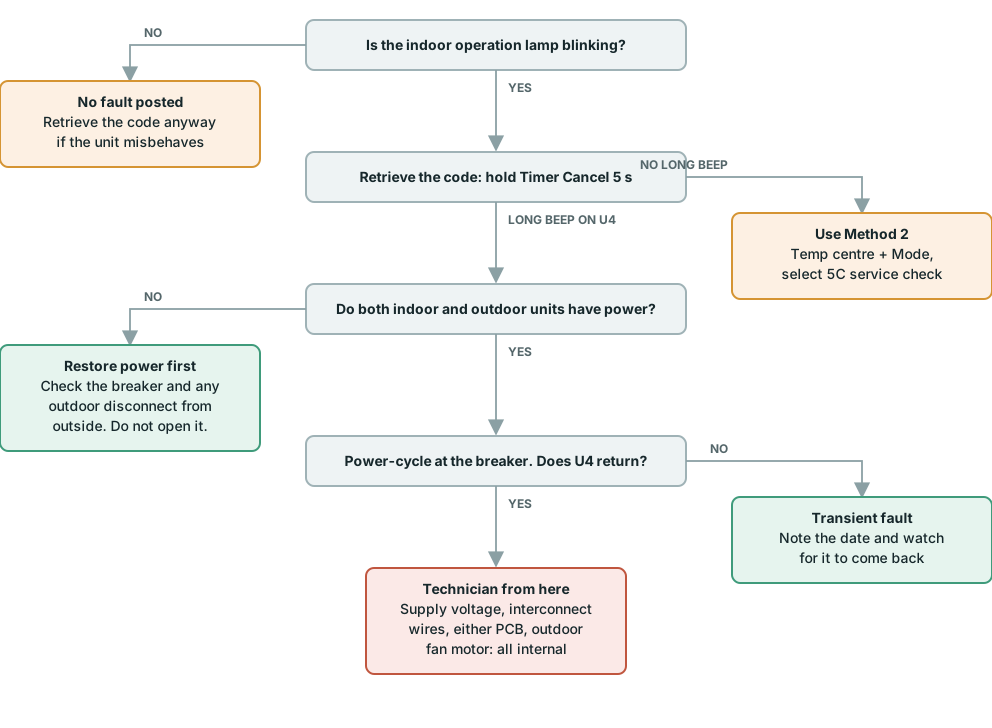
This is the whole homeowner list, and it is short because Daikin's own causes are all internal.
- Confirm both units are powered. A mini-split often has a separate disconnect or breaker for the outdoor unit. If the outdoor unit has no power, the indoor unit is not receiving data, and
U4is the expected result rather than a fault in the boards. Look at the breaker panel and at any outdoor disconnect box from the outside — do not open it. - Look at whether the outdoor unit runs at all. Fan turning, compressor audible, nothing at all: that observation is worth more to the technician than anything else you can give them.
- Note anything that happened just before.
U4appearing right after a storm, a power cut, a brownout, or work by another trade on the same circuit points at the power supply items on Daikin's cause list.U4appearing right after installation or after a head was added points at the interconnecting wiring. - Cycle the power once, at the breaker, and see whether it returns. Turn the system off at the breaker, wait, turn it back on, then retrieve the code again. A
U4that comes straight back is a real fault; that is a data point, not a repair. - Stop there. The next steps in the manual are checking the LED on the outdoor PCB with the cover off, checking the interconnecting wires for insulation and wiring errors, measuring the voltage on the indoor terminal board between terminals 1 and 3 and between 2 and 3, checking the supply waveform, and turning the outdoor fan by hand. Those are technician steps on live equipment, and Daikin puts a caution above every one of them.
Why this is not a DIY repair
Look at what Daikin's own U4 flow can conclude. It ends at one of: correct the power supply, correct or replace the connection wires between the indoor and outdoor units, replace the indoor unit PCB, replace the outdoor unit PCB, or replace the outdoor fan motor together with the outdoor main PCB. Three of those five are board or motor replacements. One is line-voltage wiring between two pieces of equipment. One is a supply-side electrical problem in the building.
There is also a detail in the cause list worth understanding, because it explains why a "communication" fault can be a hardware fault: a short circuit inside the fan motor winding is listed as a supposed cause of U4. A failing outdoor fan motor can disturb the board enough to break the data link, which is why the manual's flow asks whether the outdoor fan rotates smoothly by hand and, if it does not, replaces the motor and the main PCB together. That is not something you can infer from the code alone, and it is not something to test by putting a hand into an outdoor unit.
What to tell the technician
- The exact code (
U4), the model numbers of both the indoor and outdoor units, and which head reported it if the system is a multi-split. - Whether the outdoor unit has power and whether it does anything at all.
- Whether the fault started after a power event, after an installation, or with no trigger at all.
- Whether the code returns immediately after a power cycle.
- If the system is under warranty, Daikin's dealer network handles the call — the installer named on your paperwork is the first number to try.
Frequently asked questions
What does U4 mean on a Daikin mini-split?
A signal transmission error between the indoor unit and the outdoor unit. Daikin's own wording: the system checks whether the signal transmission data from the outdoor unit is normal, and posts U4 when the data sent from the outdoor unit cannot be received normally or its content is abnormal. It is a communication failure between the two boxes, not a diagnosis of which box is at fault.
Is U4 a wiring problem?
Wiring is on the list but it is not the only thing on it. Daikin names eight supposed causes: reduction of power supply voltage, a wiring error, a break in the connecting wires between the units (wire No. 3 specifically), a defective outdoor unit PCB, a short circuit inside the fan motor winding, a defective indoor unit PCB, a disturbed power supply waveform, and — on the multi-split's SA indoor units — power supply voltage out of specification.
Can I fix U4 myself?
Realistically, no. What an owner can do is confirm the code, confirm both units have power, note what happened just before it appeared, and power-cycle once to see whether it returns. Every step past that in Daikin's flow is on live equipment with covers off: checking LED A on the outdoor board, checking the interconnecting wires, measuring the indoor terminal board between terminals 1 and 3 and between 2 and 3, and replacing a PCB.
Does U4 mean my system is low on refrigerant?
No. Refrigerant shortage is U0 on the multi-split outdoor list, a different code entirely. U4 says nothing about the charge — it says the indoor unit is not receiving good data from the outdoor unit.
Will U4 clear on its own?
It can, if the cause was transient — a brownout or a supply disturbance, for instance. That is why cycling the power at the breaker and re-retrieving the code is a useful thing to do once. A U4 that comes straight back after a power cycle is a live fault, and that is worth telling the technician when you book the call.
Is U4 the same as UA?
No, and they get confused on new installations because both show up at commissioning. UA is mismatching of indoor and outdoor unit — the two units should not be paired at all. U4 means the pairing is valid but the message is not arriving.
Related pages
The full Daikin code tables for both families, and the retrieval procedures in more detail: Daikin mini-split error codes. The brand index is mini-split error codes.