Dehumidifier Continuous Drain Hose Setup
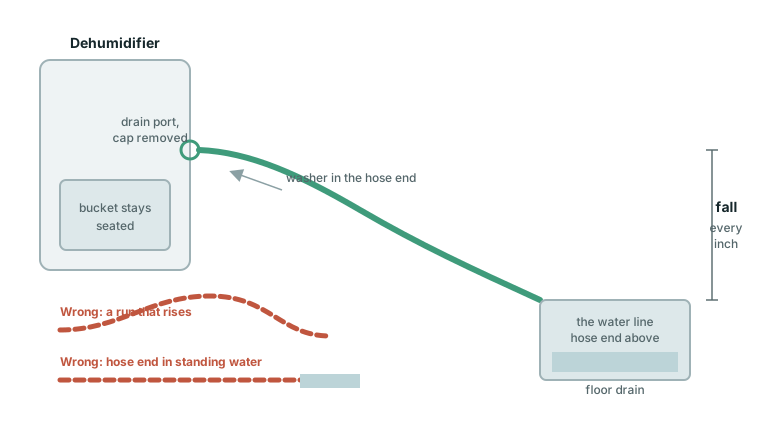
Take the drain cap off, thread on an ordinary garden hose, leave the bucket in place, and make sure every inch of the hose runs downhill. Three of those four are where people go wrong. The bucket is not optional: GE states "The bucket must be securely in place for the Dehumidifier to operate," and Hisense says the same — the unit shuts off when the bucket is out, hose or no hose. The hose must fall the whole way; Hisense's DH2524K1W manual gives the only published number, requiring the outlet to sit at least 5.5 inches below the connector. And the thread is standard 3/4-inch garden hose thread, not the 5/8 inch you will read almost everywhere — 5/8 inch is the inside diameter of the hose, not the fitting.
What size hose does a dehumidifier drain use?
A standard North American garden hose. The only manufacturer that publishes the actual thread specification is Hisense, whose manual states: "In North America the garden hose connectors are 3/4" diameter straight (non-tapered) thread with a pitch of 11.5 threads per inch." That is 3/4-inch garden hose thread — the same fitting as an outdoor spigot. GE, LG and Midea all just say "a standard garden hose."
The widely repeated "5/8 inch" figure is not a thread spec at all. It is the common inside diameter of garden hose, which is why hose sold as 5/8 inch screws onto a 3/4-inch fitting perfectly well. Buy hose by its inside diameter and it will fit; Frigidaire's only sizing guidance is a floor rather than a ceiling — "Make sure to use a large diameter garden hose 1/2" or larger or special purpose dehumidifier hose," because "Small diameter hoses will clog easily."
Where is the drain connection, and what has to come off?
The port is behind a cap or cover, and its location genuinely varies by model — there is no single answer to give. Frigidaire describes the mechanism: the unit "collects water in a tray that normally falls into the bucket but is directed to a gravity drain when the continuous drain cap is removed and replaced with a continuous drain hose."
Where you find that cap depends on the unit. Midea's MAD50PS1BQGR puts it at the back of the cabinet — "Remove drain cap by rotating counter-clockwise," shown on the rear panel in its Bucketless Mode setup. Midea's MAD20/35/50S1QWT puts it on the bucket instead: "Remove the continuous drain cover from the back of the bucket." Hisense's DH7019 family and the DH2524K1W describe the same arrangement in nearly the same words — "Uncover the connector cover on the side of the unit," then "Attach a garden hose to the drain hose connector on the inside of the dehumidifier." The cover is on the side; the fitting is behind it, inside the cabinet. LG's LD40E family says "Remove the drain-hole cover," then "Connect a garden hose to the threaded drain hose connector. Push hose connector tightly to the drain-hole on Rear Grille."
Check your own manual before hunting. Four brands put the same fitting in four different places.
Does the bucket have to stay in when using a drain hose?
Yes, on every brand that addresses it — and this is the single most common reason a newly plumbed dehumidifier refuses to run. Hisense states it without qualification: "The bucket must be installed and properly aligned for the dehumidifier to operate with or without a garden hose connected." GE is equally direct: "The bucket must be securely in place for the Dehumidifier to operate," and it must stay there "regardless of what method you use to remove water," because "The appliance will automatically shut off when the bucket is removed." LG's manual requires the bucket to be properly installed as well.
The bucket carries the float that tells the control board the unit is assembled. Take it out and the unit reads it as a removed-bucket condition and stops, whether or not water is going anywhere. There is also nothing to bypass here: no manufacturer documents defeating, repositioning or taping a float switch for continuous drain, and advice telling you to do so is not coming from a manual.
How much fall does the drain hose need?
Enough that no part of the run ever rises, and on one brand there is a published minimum. Hisense's DH2524K1W manual requires the hose outlet to sit "at least 5.5 in. lower than the hose connector," with the hose lying flat and unkinked. That is the only numeric figure any manufacturer publishes; the rest state the principle.
Frigidaire: "Make sure the hose is below the connection on the unit. It should lie flat, and as straight as possible with no kinks." Midea: "Ensure the unit is placed at a height where the unit drain port is above the drain hose outlet." GE: "Make sure the drain hose is routed downward," and the hose "needs to be laying flat on the ground and should be cut to the shortest length possible."
GE also documents the failure people never think to check. If the hose runs into a standpipe or floor drain, "make sure it is not pushed in too far. If the hose is touching water, it will not drain." A hose end submerged in the drain's own standing water stops the flow as effectively as a kink.
Setting it up
- Unplug the unit. Everything below happens with no power to it.
- Find the port and remove its cap or cover. Back of the cabinet, back of the bucket, side, or inside — see your manual. Keep the cap; you will need it if you go back to bucket emptying.
- Fit a hose washer. GE's leak article is explicit: "Make sure you have a good connection where the garden hose attaches and that there is a rubber washer properly installed in the end of the garden hose." A missing washer is an officially documented cause of leaks, and it is the part everyone forgets.
- Thread the hose on by hand and snug it. Hand-tight plus a nudge. These are plastic threads.
- Reinstall the bucket and seat it properly. The unit will not run without it.
- Route the hose so it only ever goes down. Cut it to the shortest length that reaches (GE). No coils on the floor, no loops over a joist, no dip that holds water.
- Check where the hose ends. Above the water line in the drain, not in it.
- Plug in and run it for an hour, then look for water at the fitting. A slow drip at the connector means the washer or the seating, not the unit.
Pump models: how high can they lift?
Pump-equipped units push water upward to a sink or window, and the limit is a published spec per model — do not average across brands. Midea's MAD50PS1BQGR states "The pump can pump up to 14 feet above the drain port to an elevated drain location." GE's pump models state "The drain pump can pump up to 16 vertical feet" using the included 16-foot hose, and warn against fitting a longer one. Hisense frames the same limit as a hose spec: "Hose length is 16 feet Max" and "Height should be less than 16 feet."
Two behaviors on pump models get reported as faults and are not. First, the pump usually has to be switched on: GE's procedure is to "press and hold the Pump button for 3 seconds. The Pump indicator light flashes and then stays illuminated once the pump option is set." Gravity drain needs no such step — there is no software mode to enable, only the cap to remove. Second, Midea documents that "When the pump stops running, some water will remain in the bucket — this is to keep the pump inlet submerged and prevent the pump from pumping air." Water left in the bucket on a pump model is by design.
Why is my dehumidifier not draining through the hose?
Run these in order, because the first three cover nearly all of it: the bucket is out or not fully seated, the hose rises somewhere along its run, or the hose end is submerged in the drain. After those, look at the hose itself. Frigidaire documents that "Small particles of dust normally collect in the water produced by the dehumidifier. This can form sludge and algae that can block the hose," and asks owners to "Clean the hose periodically by flushing with clean water to remove debris." A clear hose makes this visible; an opaque one does not, which is an argument for the clear kind.
One seasonal failure is worth planning around. Midea warns: "If routing the drain hose outdoors, do not operate when the outdoor temperature is at or below 32°F (0°C) as the water will freeze, blocking the hose." An outdoor run that works all summer becomes a plug in November, and the symptom looks identical to a unit that has stopped collecting — see dehumidifier not collecting water and coils freezing up.
Repair or replace?
Nothing on this page is a repair. A hose, a washer and a rethink of the route are a few dollars and twenty minutes. The one case where money is involved is a drain that sits above the unit with no gravity path available — a basement with the only drain on the far wall, for instance. There the choice is a pump model or an external condensate pump plumbed into the gravity outlet, and the external pump is usually cheaper than replacing a working dehumidifier.
When to call for service
- Water leaking from the cabinet rather than the fitting, with the hose correctly routed and the bucket seated.
- A pump model that runs but moves no water within its published lift height.
- Any electrical symptom around a wet unit: tripped breaker, warm plug, or a burning smell.
- Unit within warranty — a leaking internal tray is the manufacturer's problem, not a plumbing job.
Parts and consumables
As an Amazon Associate we earn from qualifying purchases. Links open Amazon in a new tab; prices and availability are shown there, never here.
A short hose is better than a long one coiled on the floor, and a bag of rubber washers costs almost nothing next to the leak they prevent.
- Heavy-duty 5/8 in. garden hose, short lengthFind on Amazon
- Garden hose washers (rubber)Find on Amazon
- Condensate pump (external)Find on Amazon
Related pages
If the bucket is dry and the hose is correctly routed, the unit may not be collecting at all rather than failing to drain: dehumidifier not collecting water. Iced coils produce the same dry-bucket symptom: freezing up. For what Hisense publishes about its own units, see the Hisense dehumidifier hub.
Sizing a dehumidifier for the space?Dehumidifier Sizing Calculator Pints per day under the 2019 rating, mapped to the sizes stores sell.