Dehumidifier Coils Freezing Up (Ice on the Coils)
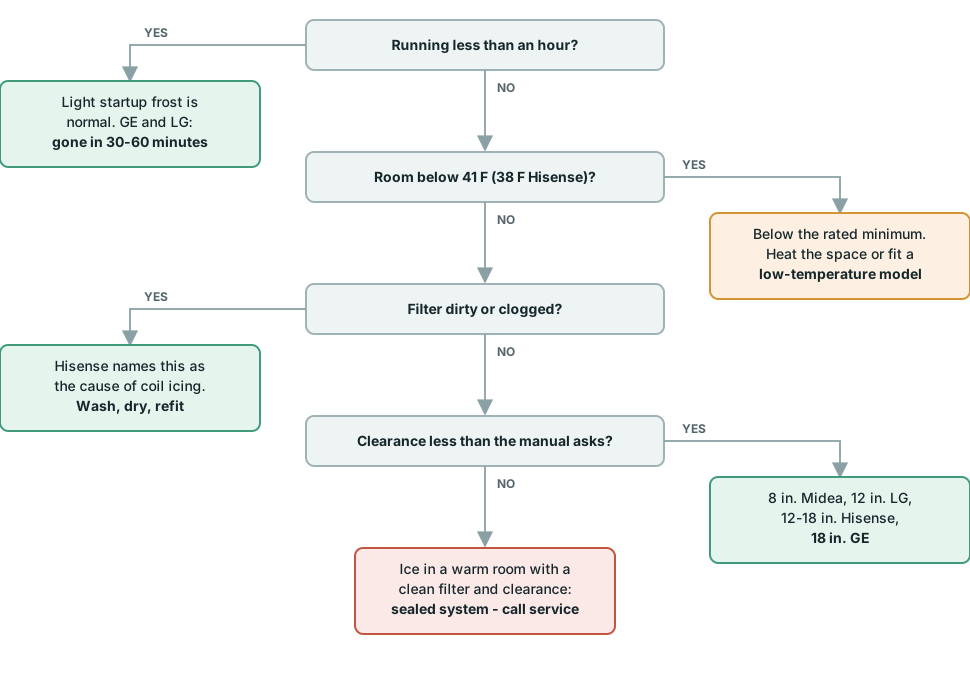
Ice on the coils is almost always one of three things: the room is colder than the unit is rated for, the filter is dirty, or the unit is jammed against a wall. A light coating of frost right after startup is documented as normal — GE says it usually clears in 30 to 60 minutes, LG says within 60. What is not normal is ice that stays. Most brands rate their units down to 41 °F: Frigidaire, GE, LG and Midea all state that limit. Hisense is the exception and states 38 °F. Below the rated minimum the coil runs below freezing and the water freezes on it instead of running into the bucket, which is why a basement in October produces "the fan runs but there's no water."
| Symptom | Dehumidifier Coils Freezing Up (Ice on the Coils) |
|---|---|
| Applies to | Residential refrigerant dehumidifiers, 20–70 pint (Frigidaire, GE, Hisense, LG, Midea and others) |
| Severity | Runs with warning |
| DIY | DIY-friendly — owner can resolve it with the manual |
| Last checked |
Why is my dehumidifier freezing up?
Because the evaporator coil is running below 32 °F and the moisture condensing on it turns to ice instead of water. That happens when the room air is too cold to begin with, or when too little air is moving across the coil to carry heat into it. Frigidaire names both: "Low ambient temperatures can promote the formation of frost," and separately, restricted airflow prevents ice from melting. Everything below is one of those two conditions.
| Cause | How to confirm | Fix | DIY? |
|---|---|---|---|
| Normal startup frost | Unit turned on within the last hour; frost is light | Nothing. GE: usually gone in 30–60 min; LG: within 60 min | DIY-friendly |
| Room below the rated minimum | Thermometer in the room reads under 41 °F (38 °F on Hisense) | Heat the space, or use a low-temperature model | DIY-friendly |
| Dirty filter | Filter gray or furry; not washed in 2 weeks | Wash, dry fully, refit — restricted airflow is the mechanism | DIY-friendly |
| Too little clearance | Unit against a wall or in a corner | 8 in. (Midea) to 18 in. (GE) depending on brand — check your manual | DIY-friendly |
| Auto-defrost working as designed | Compressor stops, fan keeps running, ice recedes | Nothing. This is the unit protecting itself | DIY-friendly |
| Sealed-system fault | Ice persists at 65 °F+ with a clean filter and full clearance | EPA 608 technician, or replace | Licensed pro / dealer |
What temperature is too cold for a dehumidifier?
Below the minimum the manufacturer prints, and that number is not the same across brands — which is why generic advice gets this wrong. Frigidaire states "The low limit is 41 F." GE says its units "will not operate satisfactorily at temperatures below 41 degrees Fahrenheit." LG states 41 °F to 90 °F. Midea's MAD20/35/50S1QWT manual gives 41 °F to 95 °F. Hisense states 38 °F across five manuals, and adds what happens below it.
Hisense's wording is the most direct any manufacturer gives: "At temperatures of 38 ºF (3.2 ºC) or less, water freezes inside the product." A second Hisense manual for the DH-35K1SCLE family puts it as an installation rule instead — "Install the dehumidifier in an area where the temperature will not fall below 38 ºF (3 ºC)."
There is a second, higher threshold that catches people out in unheated spaces. LG's manual for the LD40E family states that standard models "Do not operate satisfactorily if the room temperature is below 65°F (18°C)," while "The Low Temperature model will continuously cycle up to temperature 42°F (6°C)." That is the clearest published statement of the split between an ordinary dehumidifier and a basement or crawlspace model, and it explains why a unit that works in July ices up in October in the same room.
Is frost on the coils always a problem?
No — every brand documents light frost as normal in two situations, and reading it as a fault is the most common mistake. The first is startup. GE: "A light coating of frost on the coils is normal when the Dehumidifier is first turned on," typically gone in 30 to 60 minutes. LG's troubleshooting table lists "Frost appears on coils" with the cause given as the unit having been recently turned on, or a room below 65 °F, and the solution as "This is normal. Frost will usually disappear within 60 minutes." Midea's table is shorter still: "This is normal. The dehumidifier has Auto defrost feature."
The second is during defrost itself, which is discussed below. If the frost is light, recent, and receding, leave it alone.
How does auto-defrost work on a dehumidifier?
The unit stops the compressor so the coil warms up, and on most brands leaves the fan running to melt the ice off. Frigidaire describes the sensing side: "The unit has a sensor on the coil to detect frost and will shut off the compressor to warm the coil and melt the frost." Hisense describes the same behavior as a named function — "The de-icing function will turn off the compressor if a low temperature condition occurs. When the de-icer senses the correct operating temperature, the compressor will cycle back on."
The detail worth knowing is in the Hisense DH-35K1SCLE manual, which spells out that the de-icer "will shut off the compressor and allow the fan to run." That is exactly the state people report as a fault: the unit is plainly running, air is moving, and no water is being produced. It is the defrost cycle doing its job. Midea and LG describe the same compressor-off behavior.
No manufacturer we could find publishes how long a defrost cycle lasts, and none documents a defrost indicator light. If a page tells you to look for a defrost light on your dehumidifier, it is not reading from a manual.
Check these first
- How long has it been running? Under an hour, with light frost, is documented as normal by GE and LG. Give it the hour before doing anything else.
- Measure the room, not the basement generally. Put a thermometer at the height of the unit's intake. Under 41 °F (38 °F on Hisense) is below spec and the ice is expected, not a fault.
- Above 65 °F and still icing → keep going, this is a real problem.
- Between the rated minimum and 65 °F → a standard model may frost intermittently; LG documents this explicitly.
- Pull the filter and look at it. Hisense lists "The filter is dirty or obstructed by debris" under Dehumidifier runs but does not dehumidify, with the solution "Clean the filter" — its own "Ice forms on coils" row points only at the de-icer. So treat a dirty filter as the airflow condition behind icing rather than as Hisense's named cause of it; Frigidaire is the brand that names restricted airflow directly. Wash it, dry it completely, refit it. Midea asks for cleaning every two weeks.
- Measure the clearance. This is the one people skip and it is a documented spec, not a suggestion. GE asks for "at least 18 inches of air space on all sides." Hisense asks for 12 to 18 in. on the rear and sides for back-louver models, or above the unit for top-louver models. LG asks for 12 in. on all sides. Midea asks for at least 8 in. on all sides and 16 in. at the air outlet. Use your own manual's figure — the range across brands is more than two to one.
- Close the doors and windows. GE: "Doors and windows should be kept closed." Pulling in outdoor air in cool weather drops the intake temperature at the coil.
- Let it thaw completely before judging it. Turn the unit off and leave it for a few hours, or run it in fan mode if it has one. Then restart with a clean filter, proper clearance, and a room above 65 °F.
- Still icing under those conditions? That is the sealed system, and it is where the DIY part ends.
Brand-specific notes
Each of the five brands here contributes something the others leave out, and the differences are large enough that borrowing a figure across brands gets the answer wrong. Frigidaire names an imbalanced system as a cause; GE is the most explicit about what happens below spec; Hisense sets a different minimum entirely and documents the fan behavior; LG supplies the standard-versus-low-temperature split; Midea has the tightest clearance requirement. Read your own.
Frigidaire
Frigidaire's frost article is the only one that names an imbalanced system as a cause alongside ambient temperature and restricted airflow: "If system is imbalanced it can lower coil temperatures." Its remedy for the airflow side is the same two checks as everyone else's — "Make sure the unit has proper clearance around it and that the filter is clean."
GE
GE is the most explicit about what happens below spec: under 41 °F the coils may freeze and may need defrosting "as often as once per hour," but frost controls on current models "will turn off the Dehumidifier before a major freeze up occurs." GE also notes that some models offer a low-temperature operation setting for use below 41 °F, and directs owners to their specific model's manual to find out whether theirs has it.
Hisense
Hisense sets its minimum at 38 °F rather than 41 °F, states plainly what happens below it, and is the only brand that documents the fan continuing to run through de-icing. It also documents an upper limit with a different mechanism: above 90 °F "the internal temperature of the product trips a protective device which deactivates the product." See the Hisense dehumidifier hub for what else Hisense publishes.
LG and Midea
LG is the source for the 65 °F standard-model threshold and the low-temperature model cycling to 42 °F. Midea's contribution is the tightest clearance spec of the group — 8 in. on all sides, 16 in. at the outlet — and a troubleshooting table that treats coil frost purely as expected behavior.
When it's the sealed system
If the coil ices over in a room comfortably above 65 °F, with a clean filter and full clearance on every side, the problem is inside the refrigerant circuit — low charge, a restriction, or a failing compressor — and it is not a homeowner repair. Refrigerant circuits are sealed at the factory, and opening one requires EPA Section 608 certification. On a 20 to 50 pint unit the diagnostic call alone usually approaches the price of a replacement.
Repair or replace?
A filter, some clearance and a warmer room cost nothing and account for most of these. A unit still under warranty with a sealed-system fault goes back to the manufacturer. Out of warranty, a sealed-system repair on a residential dehumidifier is rarely economic. If the space genuinely runs below 65 °F for months at a time, the honest answer is not a repair at all — it is a low-temperature or basement-rated model, because a standard unit will keep icing in that room no matter what you fix. Size the replacement with the dehumidifier sizing calculator rather than buying the biggest one on the shelf.
When to call for service
- Coils ice over in a room above 65 °F with a clean filter and documented clearance on all sides.
- Compressor runs continuously and the bucket stays dry after a full thaw and restart.
- Burning smell, a hot plug or cord, or a breaker that trips when the unit starts.
- Unit is within its warranty period — the sealed system is the manufacturer's to touch, not yours.
Related symptoms
Ice on the coils and an empty bucket are the same complaint seen from two angles — see dehumidifier not collecting water for the version where there is no visible ice. If your unit is draining through a hose rather than a bucket, a frozen or blocked hose produces the same "not collecting" symptom: drain hose setup. On Frigidaire units, a genuine sealed-system fault has its own display code — see EC and F0.
Sizing a dehumidifier for the space?Dehumidifier Sizing Calculator Pints per day under the 2019 rating, mapped to the sizes stores sell.Frequently asked questions
Why is ice forming on my dehumidifier coils?
The coil is running below freezing, either because the room is colder than the unit's rated minimum — 41 °F on Frigidaire, GE, LG and Midea, 38 °F on Hisense — or because a dirty filter or too little clearance is starving it of airflow. Light frost in the first hour of operation is documented as normal.
Will a dehumidifier work in a cold basement?
A standard model will struggle. LG states that standard units "do not operate satisfactorily if the room temperature is below 65°F," while its low-temperature model "will continuously cycle up to temperature 42°F." For a space that stays cold, a low-temperature or basement-rated unit is the fix, not a repair.
How do I defrost a dehumidifier?
Turn it off and let it thaw for a few hours, or run it in fan-only mode if it has one. Do not chip or scrape ice off the coil — the fins bend and the tubing is thin. Then restart with a clean filter and proper clearance.
My dehumidifier fan runs but no water comes out — is it frozen?
Often, yes. Hisense documents that its de-icing function "will shut off the compressor and allow the fan to run," which looks exactly like a working unit that has stopped collecting. Pull the filter and look at the coil before assuming a fault.
How much space does a dehumidifier need around it?
It depends on the brand, and the range is wide: Midea asks for 8 in. on all sides and 16 in. at the outlet, LG for 12 in., Hisense for 12–18 in., and GE for 18 in. Use the figure in your own manual.
Is frost on the coils covered by the warranty?
Frost caused by running below the rated minimum temperature, a dirty filter, or insufficient clearance is a usage condition, not a defect. Ice that persists in a warm room with a clean filter points at the sealed system, which is what the warranty is for.
Parts and consumables
As an Amazon Associate we earn from qualifying purchases. Links open Amazon in a new tab; prices and availability are shown there, never here.
A spare washable filter is worth having so the unit can keep running while one dries; a cheap hygrometer settles the "is this room actually 60 degrees?" argument in a minute.
- Washable dehumidifier filter (universal)Find on Amazon
- Indoor thermometer and hygrometerFind on Amazon
- Coil cleaning brush setFind on Amazon