Hisense Portable Air Conditioner Error Code E5
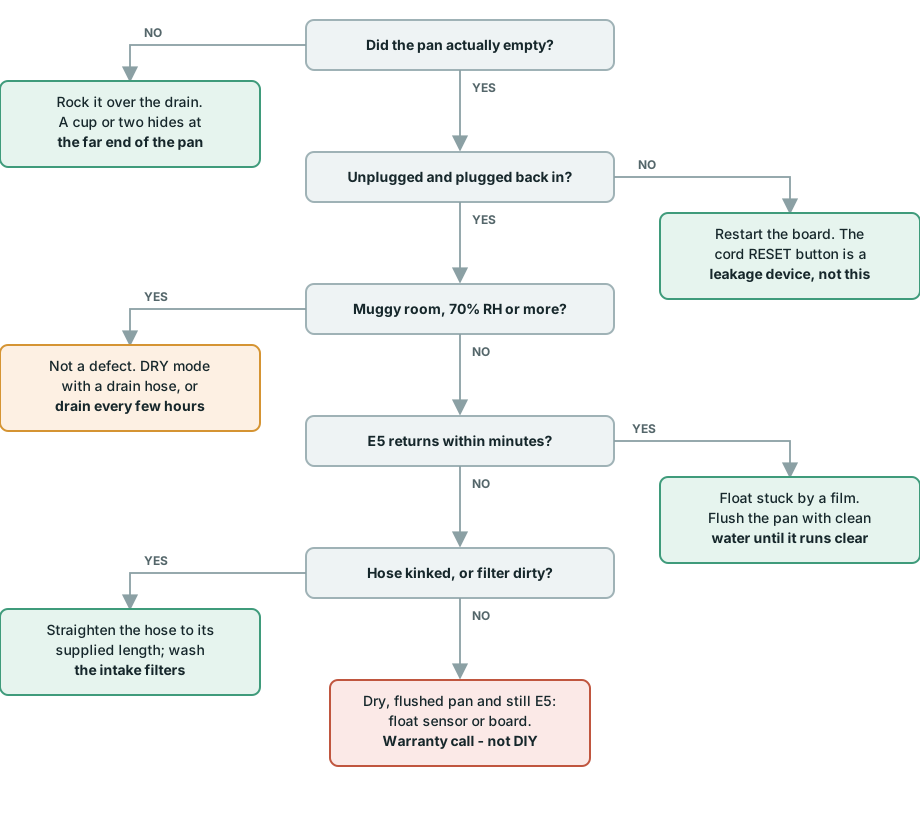
E5 on a Hisense portable AC means the water container is full. Three separate Hisense USA manuals say the same thing: "If the unit displays error code E5, the water container is full. Drain the water… After draining, the unit can be operated again." Unplug it, move it somewhere that can get wet, pull the bottom drain cap and plug, let it empty completely, put the plug back, and restart. If E5 comes back within minutes of a full drain, the unit didn't actually empty (tilt it toward the drain) or the float that senses the water is stuck — see the diagnosis below. Hisense's manuals define no other E-codes: for E1, E2, E3, E4, E6, E7, or EA they say only "contact customer service."
| Code | E5 (E5) |
|---|---|
| Applies to | Hisense portable air conditioners sold in the US (AP-series: AP0522CR1W, AP0722CW1W, AP0819CR1W, AP0822CW1W, AP1022CW1G, AP1219CR1W, AP1022TW1GD dual-hose, HAP0824TWD and similar) |
| Severity | Unit will not run |
| DIY | DIY-friendly — owner can resolve it with the manual |
| Last checked |
What E5 means
A portable AC pulls humidity out of the room as it cools. Hisense's design evaporates most of that condensate and blows it out the exhaust hose — Hisense calls it "drain-free" — but on humid days water accumulates faster than the unit can sling it out. A float in the internal pan rises, the controller stops the compressor, and the display shows E5. It's a protection code, not a fault code: nothing is broken, the pan is full.
Every Hisense US manual we checked handles error codes in one short table:
| Code | Meaning (Hisense wording) | What to do | Severity | DIY? |
|---|---|---|---|---|
| E5 | "The water container is full" | Drain per the manual; "after draining, the unit can be operated again" | Unit will not run | DIY-friendly |
| E1, E2, E3, E4, E6, E7, EA | Not defined by Hisense | "Please contact customer service" — 1-877-465-3566 | Unit will not run | Licensed pro / dealer |
You'll find sites claiming E5 is a "communication error" or an "over-voltage" fault. Those definitions belong to other brands' controllers. On Hisense's own documentation there is exactly one meaning.
How to drain it (as the manual states it)
From the AP0819CR1W and HAP0824TWD manuals:
- Unplug the air conditioner or disconnect power.
- Move it to a drain location — a bathroom, a floor drain, outside. It rolls; the pan can hold more water than you'd like on a carpet.
- Remove the primary drain cover and plug. They're at the bottom of the back panel. Keep the plug — losing it means a leak every time it runs.
- Drain the water completely through the drain hole. Tip the unit slightly toward the drain at the end; the pan isn't perfectly flat.
- Refit the plug and cover, plug the unit in, press power. E5 should be gone.
If the unit has a continuous drain port (higher up on the back, usually with a cap), you can attach a standard hose there for dehumidify (DRY) mode so the pan never fills; the hose must run downhill to a drain. Check your model's manual for which modes that port drains; on many portables the upper port only carries water in DRY mode, and in COOL mode the water still collects in the bottom pan.
Step-by-step diagnosis: E5 that keeps coming back
The manual stops at "drain it." These are the follow-ups, in order, when a full drain doesn't clear the code. None of them touch the refrigerant system.
- Did it actually empty? Pull the plug again and rock the unit front-to-back and side-to-side over the drain. A cup or two often hides at the far end of the pan. Some owners lay the unit's back edge on a 1-inch block so the drain sits lowest.
- More water came out → refit, restart. Most "E5 after draining" cases end here.
- Power reset. With the plug refitted, unplug the unit briefly and plug it back in so the control board restarts. This step is not in Hisense's manual — there is no published timed reset — it's simply how any control board gets restarted. (The RESET button on the power cord is a leakage-current safety device, not an error reset; if it has popped out, the manual says to press it until it clicks.)
- Humidity load. In a muggy room (70 %+ RH), a Hisense can fill its pan in a few hours in COOL mode. That's not a defect. Options: run DRY mode with a continuous drain hose connected, close the door to the room, or accept a drain every few hours during heat waves. An undersized unit runs longer and makes more water — check the room against the BTU calculator.
- Float switch stuck. After a drain, water can leave a film of dust or biofilm that holds the float up. With the unit unplugged and the drain open, flush a cup of clean water through the pan and let it drain; repeat until it runs clear. A tablespoon of white vinegar in the flush water helps with the slime; don't use bleach in a unit that blows air into a room.
- Code clears → done. Plan on a flush at the start of each season.
- Exhaust hose and airflow. A kinked, sagging, or overlong exhaust hose keeps hot, wet air in the unit and increases condensate. Keep the hose as short and straight as it will go (Hisense supplies it at the length it wants). Clean the intake filters — a clogged filter drops the evaporator temperature and condenses more water.
- Still E5 with a dry, flushed pan? The float sensor or the control board is reading wrong. That's a warranty call (Hisense US: 1-877-465-3566, service@hisense-usa.com) or, out of warranty, a repair-vs-replace decision — see below.
Parts, numbers, and consumables
Hisense does not publish a parts list or part numbers for its portable ACs in the user manuals, and its US support pages don't sell parts. Anything with a part number online is a third-party listing we can't verify against Hisense documentation, so none are shown here. The consumables you may actually need:
| Part | Part number | Fits | Where verified |
|---|---|---|---|
| Drain plug and cover | not published | all AP-series | Hisense manuals describe the plug; no number given |
| Drain hose for the continuous-drain port | generic — measure your port | models with a continuous-drain port | Check your model's manual |
| Exhaust hose | generic — measure yours | AP-series | Hisense manuals describe the hose; no number given |
Repair or replace?
If E5 is a full pan, the repair is free. If it's a stuck float that a flush fixes, still free. If the float switch or control board has failed on a unit out of warranty (check your paperwork for the term), be realistic: a Hisense 8,000–12,000 BTU portable sells for roughly $250–$450, and an appliance repair visit alone runs $100–$150 before parts that Hisense doesn't sell to the public. Unless the unit is under warranty or you're comfortable opening the housing yourself, replacement wins. Register the unit when you buy it; Hisense's warranty support is the only real repair path.
When to call for service
- E5 persists with a dry, flushed pan after a power reset — sensor or board, warranty claim.
- Any other code (E1–E4, E6, E7, EA) — Hisense defines none of these for owners; call 1-877-465-3566.
- Water leaking from anywhere other than the drain plug.
- Burning smell, breaker trips, or the power-cord RESET pops repeatedly.
Related codes and symptoms
A Hisense that runs but doesn't cool is a different problem from E5, and it has its own page: portable AC not cooling walks the exhaust hose, the window kit and the 95 °F rated ceiling in the order the manuals give, with Hisense's own room-size table. The causes it shares with a window unit are on window AC not cooling. Midea's equivalent of E5 is P1, and Midea documents its drain procedure in more detail; if you have a Midea, go to Midea P1.
Sizing an AC for the room?Air Conditioner BTU Calculator The ENERGY STAR sizing table with its sun, people, and kitchen adjustments.Frequently asked questions
Why does my Hisense show E5 right after I drained it?
Usually because the pan wasn't fully empty — tilt it toward the drain and rock it — or because the float is stuck in the "full" position by residue. Flush the pan with clean water and drain again, then unplug and restart the unit.
Can I run the Hisense with the drain plug out and a pan underneath?
You can, and some owners do during heat waves. The unit then drips continuously instead of stopping on E5. The pan needs emptying just as often; a hose on the DRY-mode drain port to a floor drain is the tidier version.
Does Hisense E5 mean the sensor is broken?
Not according to Hisense. The manual's only definition is "water container is full." A broken float sensor produces the same display, but it's the last thing to suspect, not the first.
How often should a portable AC need draining?
Depends entirely on room humidity. In a dry climate, a Hisense may never need it; in a humid basement or a coastal summer, every few hours in COOL mode is normal. Running DRY mode with a hose attached avoids the pan entirely.
What does the RESET button on the power cord do?
It's a leakage-current (LCDI) safety device. If it pops out, the cord cut power because it detected a fault. The manual says to press and release RESET until it clicks and stays in. It is not an error-code reset.
Parts and consumables
As an Amazon Associate we earn from qualifying purchases. Links open Amazon in a new tab; prices and availability are shown there, never here.
A continuous-drain hose for DRY mode and a low pan under the unit save most owners the mid-night drain.
- 5/8 in. portable AC drain hose with universal adapterFind on Amazon
- Low-profile drain pan (fits under a portable AC)Find on Amazon
- Replacement portable AC exhaust hose, 5.9 in. diameterFind on Amazon