Portable Air Conditioner Running but Not Cooling
Check the hose before anything else, then the weather. A portable AC dumps its heat through one flexible duct, and every manufacturer treats that duct as a fixed part of the machine. Hisense's manual is blunt: "The length of the exhaust hose is specially designed according to the specification of the product. Do not replace, extend, or otherwise modify the hose." Midea prints "Do not add extension to the exhaust hose(s)!" as its own line. After the hose, look at the outdoor temperature: Midea rates cooling to 95 °F and no manufacturer we could find publishes a higher ceiling, so a 100 °F afternoon is outside spec, not a fault. Then the ordinary things — filter, full tray, and the three-minute compressor delay that makes a working unit look dead.
| Symptom | Portable Air Conditioner Running but Not Cooling |
|---|---|
| Applies to | Single-hose and dual-hose portable air conditioners, 5,000–14,000 BTU (Hisense, Midea, LG, Frigidaire and others) |
| Severity | Runs with warning |
| DIY | Check, then call — owner-level checks first, then a dealer |
| Last checked |
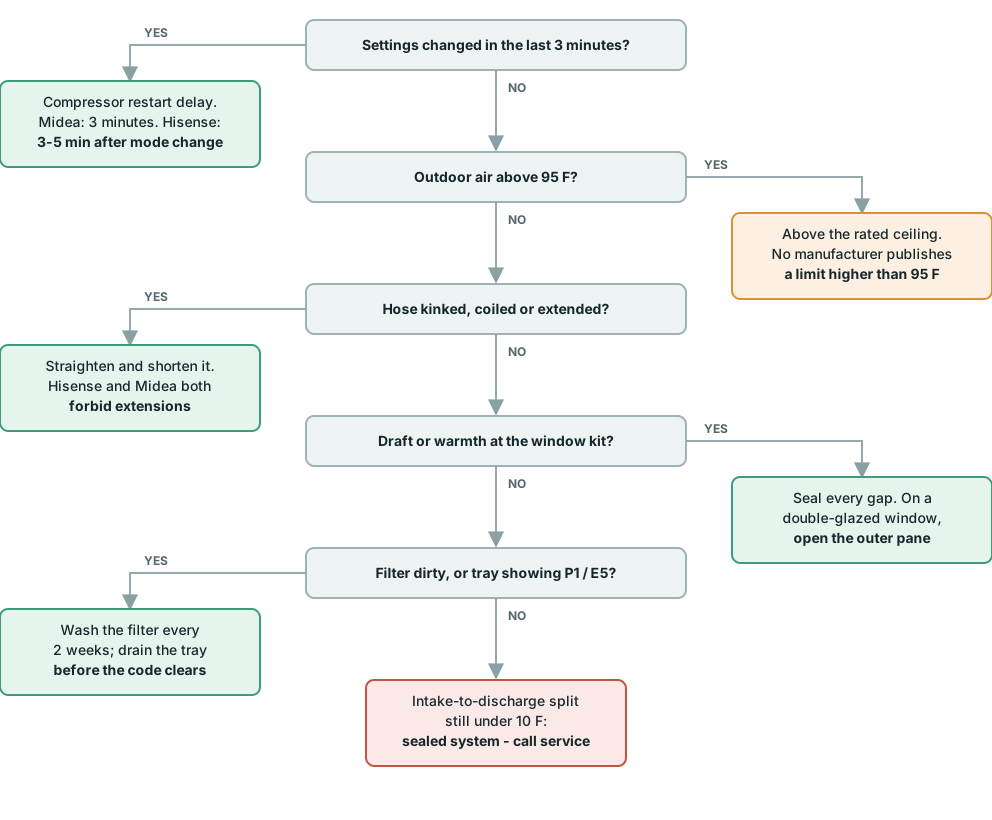
Why is my portable AC blowing warm air?
Usually because the heat it removes is not actually leaving the room. A portable unit cools by pushing hot air out through one duct, and anything that impedes that duct — a kink, a coil of slack, an extension, a gap around the window kit — sends the heat straight back into the room it just came from. The rest of the causes are shared with any air conditioner: too little airflow across the coil, a full tray, or an ambient temperature the unit was never rated for.
| Cause | How to confirm | Fix | DIY? |
|---|---|---|---|
| Compressor restart delay | Unit just switched on or mode just changed; fan runs, no cold | Wait 3 minutes (Midea); 3–5 minutes after a mode change (Hisense) | DIY-friendly |
| Outdoor temperature above spec | Above 95 °F outside | Nothing to fix — the rated ceiling is 95 °F | DIY-friendly |
| Room temperature below spec | Under 60–62 °F indoors | Cooling mode is out of range; use fan | DIY-friendly |
| Exhaust hose kinked, coiled or extended | Hose bent, looped, or lengthened beyond factory | Shortest straight run possible; no extensions | DIY-friendly |
| Window kit not sealed | Daylight or draft around the panel | Foam-seal every gap (Midea supplies strips) | DIY-friendly |
| Dirty filter | Filter gray; not cleaned in 2 weeks | Wash and dry (Midea: every 2 weeks) | DIY-friendly |
| Full condensate tray | Display shows P1; unit beeps 8 times (Midea) | Drain it | DIY-friendly |
| Room too large / heat sources | Runs constantly, never reaches set point | Size-check; remove heat sources | DIY-friendly |
| Low refrigerant or compressor fault | Everything above ruled out; coil never cold | Sealed system — EPA 608 tech or replace | Licensed pro / dealer |
How hot is too hot for a portable air conditioner?
Above 95 °F ambient, on every manufacturer spec we could verify. Midea's Duo-series manual publishes the range directly: cooling 60 °F to 95 °F, dry mode 55 °F to 95 °F, heat pump 41 °F to 86 °F. Its MAP08R1CWT manual gives 62 °F to 95 °F for cooling — note that two Midea models differ by two degrees at the bottom, which is a good reason to read your own manual rather than a general figure.
The ceiling matters more than the floor. On a genuinely hot day the condenser cannot reject heat into air that is already near its rated maximum, and the unit will run continuously while the room barely moves. That is the machine behaving as specified. No manufacturer we could reach publishes an upper limit above 95 °F, and none claims performance beyond it.
Frigidaire supplies a useful sanity check that applies to any air conditioner: the unit "will drop the temperature of the air it pulls in by 17-20F degrees before blowing out into the room." Hold a thermometer at the intake and then at the discharge. A 17–20 °F split means the machine is working and the problem is the room's heat load; a split under 10 °F means the machine is the problem.
Does the exhaust hose really have to stay the factory length?
Yes — and this is where portable ACs differ most from window units. Hisense: "The length of the exhaust hose is specially designed according to the specification of the product. Do not replace, extend, or otherwise modify the hose." Midea: "Do not add extension to the exhaust hose(s)!" and, on routing, "To ensure proper function, DO NOT overextend or bend the hose. Make sure that there are no objects within 20in (~500mm) of the inlet and outlet hose." Hisense asks for at least 20 in. of air space on all sides of the unit and no obstruction at the hose outlet.
There is one documented exception, and it is worth knowing because it contradicts the blanket advice everywhere else. LG publishes factory hose lengths — 1.5 m (4.9 ft) for 2020 models, 1.7 m (5.6 ft) for 2021 — and sells a longer one as a service part: a 2 m (6.5 ft) extension hose, part number MEJ64164703, available through LG service centers. So on an LG, a longer hose is available from the manufacturer. On everyone else's unit, the hose you have is the hose the machine was rated with.
A stretched hose is not neutral either. Extending a concertina duct thins the wall and increases its surface area, so more of the heat you are trying to expel radiates back into the room through the duct itself. Keep the run short, straight and, if it must cross the room, wrapped.
What about the window kit and the window itself?
Every gap around the panel is an opening for the hot air you just pushed outside to come back in. Midea's instruction is to "Insert the seal between the glass and the window frame to prevent air and insects from getting into the room," and its MAP08R1CWT manual has owners cut adhesive foam strips to length and fit them to the sash and frame. Run your hand around the whole perimeter on a hot day; anywhere you feel warmth is a leak worth taping.
LG documents one specific installation that defeats the whole system and is easy to miss: on a double-glazed window, "If it is installed on a double-glazed window and the outer window is closed, heat cannot escape." The exhaust is venting into the cavity between two panes. Open the outer window.
Check these first
- Give it three minutes. Midea, under the heading WAIT 3 MINUTES BEFORE RESUMING OPERATION: "After the unit has stopped, it cannot be restarted until 3 minutes time has elapsed." Hisense documents a longer delay on a mode change — "the compressor will stop for 3 to 5 minutes before restarting." Fan running with no cold air, right after you touched the controls, is expected.
- Check the mode and set point. COOL, not FAN or DRY, and set below room temperature.
- Look at the thermometer, outside and in. Above 95 °F outside is beyond the rated range. Below about 60–62 °F inside is also out of range for cooling.
- Walk the hose from the unit to the window. Straight, short, no coils on the floor, no bends tighter than a gentle curve, nothing within 20 in. of either end, and no extension fitted.
- If someone added an extension → remove it. That alone fixes a large share of these.
- Feel around the window kit. Any warmth or draft means an unsealed gap. Foam or tape it.
- On a double-glazed window, is the outer pane open? LG documents this as a cooling failure in its own right.
- Pull and wash the filter. Midea: "Be sure to clean the air filter every 2 weeks for optimal performance." LG: vacuum or soft brush; if washing, water "not exceeding 40°C (104°F)."
- Check the tray. Midea shows P1 and beeps eight times when the bottom tray fills; the unit stops cooling until it is drained. Hisense requires the collection tray drain on the back to stay accessible.
- Measure the split. Intake versus discharge, 17–20 °F is healthy. Under 10 °F with clean filter, clear hose and sealed window is a sealed-system problem.
- Count the heat sources. Midea's own list ends with "Check the room for possible heat sources and remove them if possible" and "The room area could be too large; doublecheck the cooling area."
Brand-specific notes
The three brands below publish enough detail to be worth reading separately, and each contributes something the others do not: Midea has the fullest troubleshooting table and the documented restart delay, Hisense is the only one with a room-size chart in the manual, and LG is the only one that sells a longer exhaust hose as a part. Find yours before applying a figure from another brand.
Midea
Midea publishes the most complete troubleshooting list of the group, and its "does not cool well" row is worth reading in full: blocked filter, exhaust hose not connected or blocked, set temperature too high, windows and doors open, room too large, heat sources present. The MAP08R1CWT manual adds one cause the Duo manual omits — "The unit is low on refrigerant." Midea's codes appear as families (Ehxx, Ecxx, Elxx, PCxx, PHxx, PLxx) with a generic restart-or-service instruction; P1 is the full-tray code and is the one owners actually meet. See Midea P1.
Hisense
Hisense is the only brand here that publishes a room-size table in the manual, and it is the only place any manufacturer we read separates single-hose from dual-hose sizing: up to 150 sq ft for 5,000 BTU single hose, 250 for 6,000, 300 for 7,000, 350 for 8,000, then 450 sq ft for 10,000 BTU dual hose and 550 sq ft for either 10,000 BTU single hose or 12,000 BTU single hose — with the qualifiers "Shaded room reduce to next smaller size. Sunny room increase to next larger size. For kitchens, increase to next larger size." Its full-tank code is E5, which is not in the AP0522CR1W manual — that manual carries no code table; see Hisense E5 for the model documentation that does cover it.
LG
LG's guidance is mostly about installation and airflow: clean a dusty filter because "the cooling capacity may be reduced," and "Leave enough space between the wall and the product before using the unit. (There should be no obstacles within 20cm(7.8in) around the product.)" LG is also the only manufacturer with an official longer exhaust hose.
A note on single-hose versus dual-hose
The argument for dual-hose units — that a single-hose machine exhausts room air, creates negative pressure, and draws warm outside air back in through gaps — is an enthusiast and reviewer framing, and no manual we examined describes that mechanism. Midea's Duo manual covers a dual-hose machine and says nothing about intake air, negative pressure or infiltration; it refers only to "exhaust hose(s)."
One manufacturer does publish a difference, though not an explanation. Hisense's room-size table rates the same 10,000 BTU capacity at 450 sq ft in dual-hose form and 550 sq ft in single-hose form. That is a sizing table, not a mechanism, and we are not going to reason one out of it — but it is the closest thing to manufacturer documentation on the question that we found, and it is worth knowing before you pay a premium for a second hose.
We are not saying the physics is wrong. We are saying that under this site's sourcing rule we will not present it as manufacturer guidance, and neither should anyone quoting a manual at you. What the manuals do document about the exhaust path — no extensions, no kinks, 20 in. of clearance, seal the window — is verifiable and is where the fixable problems are.
When it's the sealed system
If the exhaust path is right, the filter is clean, the tray is empty, the room is within the rated range, and the intake-to-discharge split is still under 10 °F, the refrigerant circuit is at fault. Only Midea's MAP08R1CWT manual names low refrigerant as a documented cause, and it is a service item either way: refrigerant circuits are sealed and opening one requires EPA Section 608 certification. On a portable unit that usually means replacement rather than repair.
Repair or replace?
Sealing, unkinking and cleaning are free and fix most of these. A window kit or a foam seal set is a few dollars. A replacement hose from the manufacturer is reasonable on an LG. Beyond that, portable ACs are not economic to repair at the sealed system, and the running cost of an old one is worth checking before spending anything — try the electricity cost calculator. If the unit is simply too small for the room, no repair helps; size it with the BTU calculator.
When to call for service
- Intake-to-discharge split under 10 °F with a clean filter, clear hose and sealed window.
- Compressor hums, strains, then clicks off repeatedly.
- Water leaking from the cabinet rather than the drain, or a tray that refills within minutes of draining.
- Burning smell, hot plug, or a breaker that trips on start-up.
Related symptoms
A window unit shows most of the same causes without the hose: window AC not cooling. If the unit has stopped because of water rather than heat, the two codes to know are Hisense E5 and Midea P1.
Sizing an AC for the room?Air Conditioner BTU Calculator The ENERGY STAR sizing table with its sun, people, and kitchen adjustments.Frequently asked questions
Why is my portable air conditioner running but not cooling?
Work the exhaust path first — no extension on the hose, no kinks or coils, 20 in. clear at both ends, and every gap around the window kit sealed. Then check the outdoor temperature against the rated 95 °F ceiling, then the filter and the condensate tray.
Can I extend my portable AC exhaust hose?
Not on most brands. Hisense says do not replace, extend or modify the hose; Midea prints "Do not add extension to the exhaust hose(s)!" LG is the exception and sells an official 2 m (6.5 ft) extension hose, part MEJ64164703, through its service centers.
What temperature range is a portable AC rated for?
Midea's Duo series is rated 60–95 °F for cooling and 55–95 °F for dry mode; its MAP08R1CWT is 62–95 °F for cooling. No manufacturer we could verify publishes a ceiling above 95 °F.
Why does my portable AC blow cold then warm?
If it alternates over minutes, that is normal thermostat cycling. If it went warm and stayed warm after you changed a setting, it is the compressor restart delay — three minutes on Midea, three to five on Hisense after a mode change.
What does P1 mean on a portable air conditioner?
On Midea units, the bottom tray is full: "P1 - Bottom tray is full - Connect the drain hose and drain the collected water away." The unit beeps eight times when it reaches the level. Hisense uses E5 for the equivalent condition.
Is a dual-hose portable AC better than a single-hose one?
No manual we examined describes negative pressure or infiltration, including Midea's own dual-hose manual, so we won't present that argument as manufacturer guidance. The one published difference is Hisense's sizing table, which rates 10,000 BTU at 450 sq ft dual-hose and 550 sq ft single-hose. What is documented for both types is that the exhaust path must be short, straight, unextended and sealed.
Parts and consumables
As an Amazon Associate we earn from qualifying purchases. Links open Amazon in a new tab; prices and availability are shown there, never here.
The window seal kit and hose wrap address the two causes that account for most complaints; the IR thermometer settles whether the machine or the room is at fault in under a minute.
- Portable AC window kit seal (foam and cloth)Find on Amazon
- Exhaust hose insulation wrapFind on Amazon
- Infrared thermometerFind on Amazon