Carrier Furnace Code 13: Limit Circuit Lockout
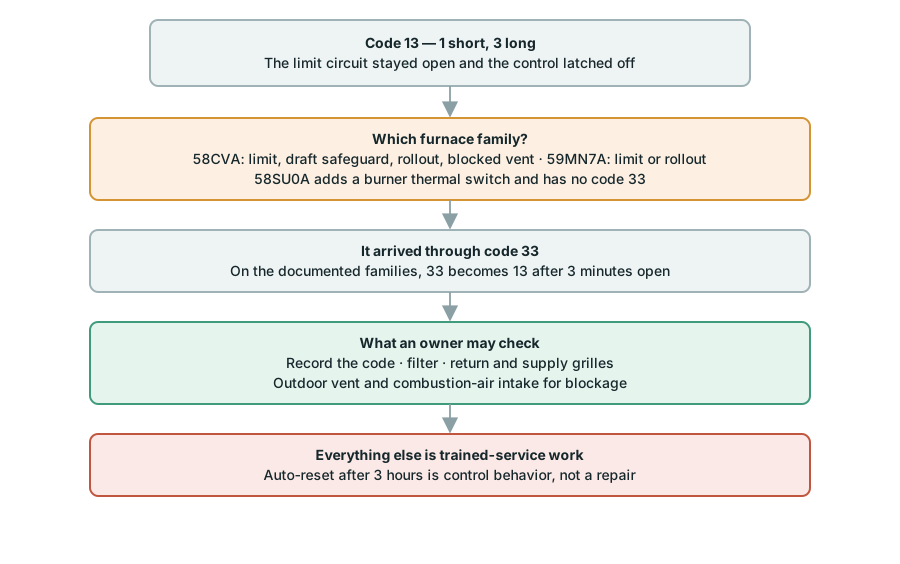
Code 13 — one short flash, then three long — is a lockout: the furnace's limit circuit was open long enough that the control stopped trying and latched itself off. Carrier documents a three-hour auto-reset on every family where the code appears. What it does not document is one universal cause, because the limit circuit is not the same set of switches on every furnace. On a 58CVA it covers "the limit, draft safeguard, flame rollout, or blocked vent switch (if used)"; on a 59MN7A it is "the limit, or flame rollout switch"; on the 58SU0A Ultra-Low-NOx control it includes a burner thermal switch. Code 13 almost always arrives after code 33, which is the same circuit reporting itself open while the blower still runs. This is a lockout on a gas appliance, and Carrier reserves the diagnosis for a trained technician.
| Code | 13 (Limit circuit lockout) |
|---|---|
| Applies to | Carrier gas furnaces with a 2-digit status LED — documented on 58CVA/58CVX, 58SC0A/58SC1A, 59MN7A and the 58SU0A Ultra-Low-NOx control, with different switch lists on each |
| Severity | Unit will not run |
| DIY | Licensed pro / dealer — dealer or licensed pro from the start |
| Last checked |
What does code 13 mean on a Carrier furnace?
It means the limit circuit was open for longer than the control tolerates, so the furnace shut down and latched. The limit circuit is a safety loop: when it opens, the furnace has detected that something is too hot or that combustion products are not leaving properly. Carrier's response on every documented family is the same — stop the burners, run the blower, and lock out.
The differences are in which switches sit in that loop, and in what else can trigger the lockout. Two families also latch after repeated trips rather than one long one.
| Furnace family | Carrier's documented wording | Source |
|---|---|---|
| 58CVA / 58CVX | "Lockout occurs if the limit, draft safeguard, flame rollout, or blocked vent switch (if used) is open longer than 3 minutes or 10 successive limit trips occurred during high−heat. Control will auto reset after 3 hours. Refer to status code #33." | TG-GFC80-02, p. 6 |
| 58SC0A / 58SC1A | "Lockout occurs if the limit, draft safeguard, flame rollout, or blocked vent switch (if used) is open longer than 3 minutes. Control will auto-reset after 3 hours. See code 33." | 58SC0A-05SI, p. 37 |
| 59MN7A Series 100 | "Lockout occurs if the limit, or flame rollout switch is open longer than 3 minutes or 10 successive limit trips occurred during maximum-heat. Control will auto reset after 3 hours. Refer to status code #33." | 59MN7A-01T, p. 8 |
| 58SU0A Series 2 & 3 (Ultra-Low-NOx) | "Lockout occurs if a limit, draft safeguard, burner thermal switch or blocked vent switch (if used) is open. Control will auto-reset after three hours." | GFULN80-C-01TS, p. 6 |
Three things are worth pulling out of that table. The 58SU0A has a burner thermal switch in its limit circuit that the others do not, and its entry carries no cross-reference to code 33 — because that board has no code 33. The 58CVA and 59MN7A can latch after ten successive limit trips in high or maximum heat, without any single three-minute opening. And the 59MN7A's limit circuit is the shortest of the four, naming only the limit and flame rollout switches.
Why does the furnace show 13 instead of 33?
Because 13 is what 33 becomes. Code 33 is the live condition — the limit circuit is open right now and the blower is running to clear heat. Carrier's 58CVA guide spells out the transition: on code 33, "if open longer than 3 minutes, code changes to lockout #13" (TG-GFC80-02, p. 7).
That makes the two codes a sequence rather than two separate problems. If you are seeing 13, the furnace passed through 33 on the way. If you catch it early enough you may see code 33 instead, which is the same circuit reporting the same trouble before the control gives up on it.
What happens during the three-hour auto-reset?
The control releases the lockout by itself after three hours and tries again. That is a documented control behavior, not a repair. If the underlying condition is still there — a blocked return, a failing blower motor, a restricted vent — the furnace will trip, run its blower, and latch a second time, and you will be back at code 13 with three more hours of no heat.
Waiting out the timer repeatedly is the one thing worth avoiding here. A limit circuit opens because a safety device did its job, and the switches in that loop on several of these families include flame rollout and blocked vent switches, which exist because of combustion problems rather than comfort problems.
What can I check myself before calling?
A short list, all of it outside the furnace cabinet. Carrier's owner's manual supports reading the status code through the view port without opening anything, and it asks owners to write the number down first: "record the LED status code BEFORE removing the blower access door or turning off 115-v power to the furnace" (90GSFRN-C-03OM, p. 10).
- Write down the code. Count the flashes through the view port and record 13 before touching power. On some Carrier boards a power interruption erases the stored code.
- Check the air filter. A clogged filter starves airflow across the heat exchanger, and heat that cannot leave is exactly what opens a limit switch. Carrier's manual asks owners to check it every four weeks.
- Open the registers. Carrier's owner-level airflow check is to look for "blocked return-air or supply-air grilles" and be sure "they are open and unobstructed" (90GSFRN-C-03OM, p. 10). Closed-off rooms are a common cause of a hot furnace.
- Look outside at the vent and intake. The manual tells owners to check "the combustion-air intake adjacent to the furnace or outside your home for blockage" and the vent pipe outside "for blockage" (p. 9).
- Stop there. Everything past this point — the limit switch itself, the flame rollout switch, the blower motor, the heat exchanger — is diagnosis Carrier assigns to trained service personnel.
Why this page will not tell you to reset the switch
Because a rollout or limit switch that has tripped is reporting a condition, and the reset is not the fix. Some Carrier owner's manuals do describe pressing a manual reset button on the burner box once, and the same passage sets the limit on it: if it trips again, "shut down the furnace and call for service" (90GSFRN-C-03OM, p. 11). That instruction is written for the specific furnaces those manuals cover, and it is not a general Carrier procedure.
There is no documented homeowner procedure for bypassing, jumpering or testing the switches in a limit circuit, and there should not be. A limit circuit that keeps opening on a gas furnace is a heat or venting problem, and defeating the switch removes the protection without addressing what tripped it.
When to call a technician
- Code 13 returns after the three-hour auto-reset, with a clean filter and open registers.
- The furnace latches repeatedly over a day, even if it runs in between.
- You saw code 33 before it, and it has now become a lockout.
- The burner flames are not clear blue, or the furnace makes a loud noise when they light — Carrier treats both as a call rather than a check.
- Any soot, rust or scale is visible, or the vent pipe has holes or a disconnected section. Carrier's instruction there is to stop using the furnace.
Ask the technician which switch in the limit circuit actually opened, and why. On a 58CVA that is a wider set of possibilities than on a 59MN7A, and the answer tells you whether you are looking at an airflow problem or a combustion one.
Related Carrier codes
Code 13's immediate neighbor is code 33, the live limit-circuit fault that becomes 13. The ignition side of the furnace has the same fault-then-lockout structure in code 34 and code 14. The full documented list, including the codes without their own pages, is on the Carrier furnace error codes hub.
Frequently asked questions
Is Carrier code 13 the same on every furnace?
The lockout behavior is consistent, but the switch list is not. The 58CVA includes a draft safeguard and blocked vent switch, the 59MN7A names only limit and flame rollout, and the 58SU0A adds a burner thermal switch. Check your model before assuming a cause.
How long does Carrier code 13 last?
Carrier documents a three-hour auto-reset on every family where code 13 appears. The control clears the lockout itself and retries. If the condition that opened the limit circuit is still present, the furnace will lock out again.
Can I clear code 13 by turning the power off and on?
It stops the lockout timer but fixes nothing, and on Carrier's red-LED boards the stored code is erased when 115 V or 24 V power is interrupted. That removes the one piece of diagnostic history a technician would have started from.
Does code 13 mean my heat exchanger is cracked?
Not by itself. Code 13 says a switch in the limit circuit opened, most often because heat could not leave the furnace fast enough. A cracked heat exchanger is one possible finding among several, and confirming or ruling it out is a technician's job.
What is the difference between Carrier code 13 and code 33?
They are two stages of one event. Code 33 is the limit circuit open while the blower still runs; code 13 is the lockout the control latches when the circuit stays open past three minutes, or after ten successive trips on some families.