Carrier Furnace Code 34: Ignition Proving Failure
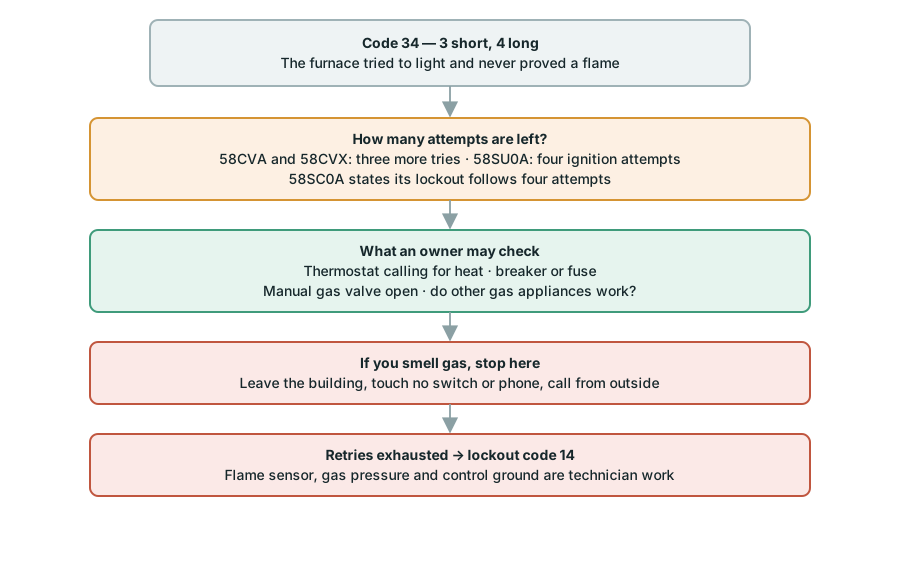
Code 34 — three short flashes, then four long — means the furnace went through an ignition attempt and never proved a flame. Either the gas did not light, or it lit and the control could not sense it. Unlike a lockout, code 34 means the furnace is still trying: Carrier documents a fixed number of retries before it gives up and latches code 14. The retry count is one of the few places Carrier's families differ cleanly. On the 58CVA and 58CVX, "control will try three more times before lockout #14 occurs." On the 58SU0A Series 2 and 3 Ultra-Low-NOx board, "control will try ignition four times before lockout #14 occurs." The published cause lists for this code are flame-sensing and gas-supply items that Carrier addresses to trained service personnel, not to owners.
| Code | 34 (Ignition proving failure) |
|---|---|
| Applies to | Carrier gas furnaces with a 2-digit status LED — 58CVA/58CVX, 58SC0A/58SC1A, 59MN7A and the 58SU0A Ultra-Low-NOx control, which retries a different number of times |
| Severity | Runs with warning |
| DIY | Check, then call — owner-level checks first, then a dealer |
| Last checked |
What does code 34 mean on a Carrier furnace?
It means the ignition sequence ran and the control did not get a flame signal back. Carrier calls it ignition proving failure, and the word "proving" is precise: the furnace is not reporting that gas failed to light, it is reporting that it could not confirm a flame. Those are different situations with different causes, which is why the code covers both.
The furnace has not stopped at this point. It purges and tries again, and the number of attempts left is set by the control.
| Furnace family | Retries before lockout | Carrier's documented wording | Source |
|---|---|---|---|
| 58CVA / 58CVX | Three more attempts | "Control will try three more times before lockout #14 occurs. If flame signal is lost during blower on−delay period, blower will come on for the selected blower off−delay." | TG-GFC80-02, p. 8 |
| 58SU0A Series 2 & 3 (Ultra-Low-NOx) | Four ignition attempts | "Control will try ignition four times before lockout #14 occurs. If flame signal lost during blower on-delay period, blower will come on for the selected blower off-delay." | GFULN80-C-01TS, p. 6 |
| 58SC0A / 58SC1A | Four attempts total, stated from the lockout side | Code 14: "System failed to ignite gas and prove flame in 4 attempts." | 58SC0A-05SI, p. 37 |
The practical meaning of that difference is small but real: on a furnace that retries, you may hear several ignition attempts in a row before anything latches, and that is documented behavior rather than a furnace struggling in a way it should not.
Why does the furnace try again instead of stopping?
Because a single failed light is a common and often self-correcting event — a slug of air in the gas line after a supply interruption, a slow first light on a cold morning. Carrier's controls are built to retry a fixed number of times and only then latch, which is why code 34 is a warning and code 14 is a stop.
It also means the code you catch depends on when you look. A furnace that shows 34 is mid-sequence. The same furnace half an hour later may be showing 14, having used up its attempts. If you saw 34 and now see 14, you are looking at one event, not two problems.
What can an owner check on code 34?
Very little inside the furnace, and that is deliberate. Carrier's published check list for code 34 is flame-sensor oxide buildup, flame-sense microamps, inlet gas pressure, control ground continuity, gas valve condition, and burner carryover — every item of it measurement or repair work on gas and electrical components. None of that belongs to an owner.
What the owner's manual does support is confirming that the furnace was actually asked to run, and that its gas and power supplies are in the state they should be.
- Read and record the code through the view port before touching power or doors, and note whether it is still 34 or has become 14.
- Check the thermostat is calling for heat and set above room temperature. A furnace that is not being asked to run cannot prove a flame.
- Check the breaker or fuse for the furnace circuit. Carrier lists both among the things an owner checks before requesting a service call.
- Check that the manual gas valve is open and the gas valve control switch is ON, as described in your furnace's own owner's manual. Do not adjust anything else on the valve.
- Ask whether other gas appliances work. If the range and water heater are also out, the problem is upstream of the furnace and belongs to the gas utility.
- Stop there. Do not clean the flame sensor, measure gas pressure, or test the control ground. Carrier assigns those to trained service personnel.
If you smell gas at any point
Leave. This is the one situation on this page where troubleshooting ends immediately and completely. Carrier prints the instruction on the front of its owner's manuals: do not try to light any appliance, do not touch any electrical switch and do not use any phone in the building, leave immediately, and call the gas supplier from a neighbor's phone — and if you cannot reach them, the fire department.
A furnace that repeatedly tries and fails to light is a furnace that has been putting gas into a burner box without confirming it burned. That is precisely why the control counts attempts and locks out rather than retrying forever, and it is why a persistent code 34 is a service call rather than a wait-and-see.
When to call a technician
- Code 34 appears more than once in a heating season, even if the furnace eventually lights.
- The code has become code 14, which means the retries are used up.
- You hear repeated clicking or ignition attempts followed by silence, with no heat.
- The burner flames are not clear blue when they do light, or lighting is accompanied by a loud noise — Carrier treats delayed ignition as a call.
- Any smell of gas, at any point, at which point the instruction above replaces everything on this page.
Related Carrier codes
The lockout at the end of this sequence is code 14. The limit side of the furnace has the same two-stage structure, with code 33 as the live fault and code 13 as its lockout. The Carrier furnace error codes hub carries the full documented list and the flash decoder.
Frequently asked questions
How many times will a Carrier furnace try to light?
It depends on the control. Carrier documents three more attempts after the first failure on the 58CVA and 58CVX, and four ignition attempts on the 58SU0A Series 2 and 3 Ultra-Low-NOx board. The 58SC0A describes its lockout as following four attempts.
Is Carrier code 34 the same as code 14?
They are consecutive stages. Code 34 is the ignition proving failure while the control still has retries left; code 14 is the lockout it latches once those retries are used up. Seeing both in one evening is one event.
Can I clean the flame sensor to fix code 34?
Carrier lists flame-sensor oxide buildup among the causes, but that check appears in service literature written for technicians and involves opening the furnace. Carrier reserves everything past filter cleaning for trained service personnel.
Why does my furnace click several times then stop?
That pattern matches a control running its documented retry sequence and then locking out. Each click is an ignition attempt that did not prove a flame. When the attempts run out, the code becomes 14 and the furnace waits out a three-hour timer.
Could a code 34 be caused by the gas being off?
Yes, and it is worth ruling out first. If the manual gas valve is closed, the gas valve control switch is off, or the utility supply is interrupted, the furnace will try to light and fail to prove a flame. Check whether other gas appliances still work.