Carrier Furnace Error Codes
A Carrier furnace reports faults as a two-digit status code, and the LED spells it out in two kinds of flash: the number of short flashes is the first digit, the number of long flashes is the second. Carrier states it plainly in its own literature — "Each of the following status codes is a two digit number with the first digit determined by the number of short flashes and the second digit is the number of long flashes" (GFULN80-C-01TS, p. 6). So one short flash followed by three long flashes is code 13, and three short followed by four long is code 34. The meanings, however, are not universal across Carrier furnaces. Code 33 does not exist at all on some Ultra-Low-NOx boards, code 31 carries five materially different meanings depending on the control, and code 12 is not a fault. Find your furnace's model number before you trust any code list, including this one.
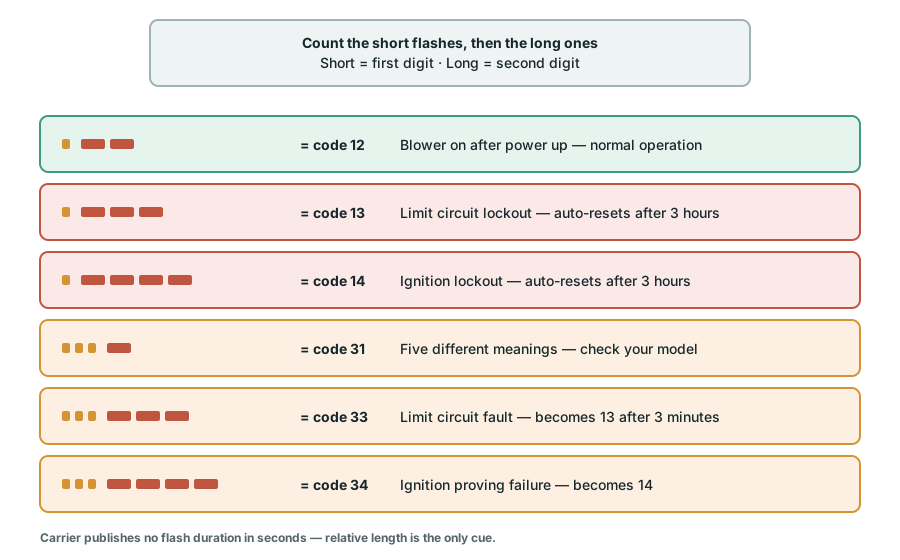
How do you read a Carrier furnace status code?
Count the short flashes, then count the long flashes. The short count is the first digit and the long count is the second, so three short flashes followed by three long flashes is code 33. Carrier repeats this same sentence across generations of literature, from 1990s troubleshooting guides to 2020s installation instructions, and the convention itself has never changed.
Two states are not codes at all. Carrier documents a continuously lit LED as the control simply having 24 V power, and rapid continuous flashing as reversed line-voltage polarity (GFULN80-C-01TS, p. 6). Neither is a two-digit code, and neither should be counted as one.
One thing Carrier does not publish anywhere is how long a short flash or a long flash lasts. There is no figure in seconds or milliseconds in any of the documents cited on this page. You are meant to tell them apart by relative length, which is why watching two or three full cycles before deciding is worth the wait.
Check your furnace model before you use any code list
The model number is on the rating plate inside the furnace cabinet, and it decides which code table applies to you. Carrier has shipped several generations of furnace control, and while they share the flash convention, they do not share every code meaning. A list that says "Carrier code 31 means X" without naming a furnace family is wrong for most readers by construction.
The clearest example is code 33. On a 58CVA or a 58SC0A it is a documented limit-circuit fault. On the 58SU0A Series 2 and 3 Ultra-Low-NOx control the code list runs 11, 12, 13, 14, 21, 22, 23, 24, 25, 31, 34 — it goes straight from 31 to 34, and there is no code 33 on that board at all (GFULN80-C-01TS, p. 6).
What the status LED color tells you
Carrier used a red status LED on the older induced-combustion furnaces and an amber one on later controls. The troubleshooting guide for the two-stage 58UHV/58TUA/58TMA family asks the technician whether the "RED LED status light" is flashing (58-3T, p. 3), while the 58CVA/58CVX guide asks the same question about the "AMBER LED status light" (TG-GFC80-02, p. 2).
The color also changes how long a stored code survives. Carrier's 58SC0A instructions note that on controls with an amber LED, "the stored status code will not be erased from the control memory, if 115- or 24-v power is interrupted" (p. 31) — but that stored codes clear after 72 hours, and that "on RED LED boards stored status codes can also be erased whenever power (115V or 24V) is interrupted" (p. 37). On a red-LED furnace, cutting power to look at something can erase the evidence.
A related Carrier-family platform is worth naming so you do not misread it: the 926SB and 926TC use a three-digit major-and-minor scheme, where the LED flashes only the major two digits and the third digit appears on a display (II926SB-01, p. 63). A plain two-digit Carrier table does not apply to those furnaces.
Carrier status codes at a glance
These are the codes people look up most often, with the family each documented meaning belongs to. Where a code has its own page, the meaning there is broken out by furnace family rather than flattened into one answer.
| Code | Flashes | Documented meaning | Applies to | DIY? |
|---|---|---|---|---|
| 12 | 1 short, 2 long | Blower on after power up — normal operation, not a fault | 58CVA/58CVX, 58SC0A, 59MN7A and related | DIY-friendly |
| 13 | 1 short, 3 long | One short flash and three long: the limit circuit stayed open too long and the control latched off. | Documented across families, with different switch lists | Licensed pro / dealer |
| 14 | 1 short, 4 long | One short flash and four long: the furnace used up its ignition attempts without proving a flame and latched off. | Documented across families | Licensed pro / dealer |
| 31 | 3 short, 1 long | Pressure-switch or transducer fault — five different official meanings by control | Model-dependent; no single answer | Licensed pro / dealer |
| 33 | 3 short, 3 long | Three short flashes and three long: a switch in the limit circuit is open right now and the blower is running to clear heat. | 58CVA/58CVX, 58SC0A, 59MN7A and related | Check, then call |
| 34 | 3 short, 4 long | Three short flashes and four long: the furnace lit, or tried to, and never proved a flame. | Documented across families | Check, then call |
Code 12 is normal. Carrier's own wording on the 59MN7A is "12 BLOWER ON AFTER POWER UP – (115 VAC or 24 VAC) – Normal operation. Blower runs for 90 seconds, if unit is powered up during a call for heat" (p. 8), and the 58SC0A table carries the same "Normal operation" qualifier (p. 37). A furnace flashing 1 short and 2 long after a power cut is reporting that it restarted, not that it is broken.
Code 31 has no single meaning. Across five official Carrier documents it is described five different ways: a high-heat pressure switch or relay fault on the 58CVA/58CVX (TG-GFC80-02, p. 7) and on the older two-stage family (58-3T, p. 19); a general pressure switch that "did not close or reopened" with a 5-minute and 15-minute retry behavior on the 58SC0A (p. 37); a medium or high pressure switch or PSR relay on the 59MN7A (p. 8); and on the 58SU0A Ultra-Low-NOx control, "31 PRESSURE TRANSDUCER INPUT DOES NOT SENSE TARGET PRESSURE OR PRESSURE IS OUT OF RANGE" (GFULN80-C-01TS, p. 6). That is a pressure switch on one furnace and a pressure transducer on another. There is no honest way to write one code 31 page, so this site does not have one — look the code up in the literature for your exact model.
How a fault becomes a lockout
Two of these codes come in pairs, and Carrier documents the transition explicitly. Code 33 is the live fault while the blower is still running; if the switch stays open long enough, the control gives up and latches. The 58CVA guide states that on code 33, "if open longer than 3 minutes, code changes to lockout #13" (TG-GFC80-02, p. 7), and the 58SC0A instructions say the same (p. 37).
Ignition works the same way. On code 34 the control keeps trying: "Control will try three more times before lockout #14 occurs" on the 58CVA/58CVX (TG-GFC80-02, p. 8), and "Control will try ignition four times before lockout #14 occurs" on the 58SU0A Ultra-Low-NOx board (GFULN80-C-01TS, p. 6). When the retries run out you get code 14, which the 58SC0A describes as the system having "failed to ignite gas and prove flame in 4 attempts" (p. 37).
So seeing 33 or 34 means the furnace is still trying. Seeing 13 or 14 means it has stopped trying and is waiting out a three-hour timer.
What can a homeowner safely check?
Carrier's owner's manual is unusually clear about this, and the boundary is narrower than most people expect. The manual names the homeowner as someone who may read the code — the LED display exists "to aid the installer, service technician, or homeowner" and "can be seen through the view port in the blower access panel" (90GSFRN-C-03OM, p. 11). Reading it costs you nothing and opens nothing.
Record the number before you touch anything else. Carrier's instruction is to "record the LED status code BEFORE removing the blower access door or turning off 115-v power to the furnace" (p. 10), which matters especially on the red-LED boards described above, where a power interruption can wipe the stored code.
Beyond reading the code, the manual supports a short list of no-tools checks: a dirty air filter; return-air and supply-air grilles that should be "open and unobstructed" (p. 10); the thermostat setting; fuses and breakers; and, outside the house, the combustion-air intake and the vent pipe, which the manual tells owners to check "for blockage" (p. 9).
When to stop and call a technician
Everything else. Carrier states the boundary in the same words across its owner's manuals and its service literature: "Only trained and qualified personnel should install, repair, or service heating equipment. Untrained personnel can perform basic maintenance functions such as cleaning and replacing air filters. All other operations must be performed by trained service personnel" (90GSFRN-C-03OM, p. 2).
Some conditions end the troubleshooting immediately rather than merely handing it over. Carrier's owner's manuals instruct owners not to operate the furnace at all if holes are found in the vent pipe or a section has come apart, if dirt, rust, soot or scale has accumulated, or if any part of the furnace has been under water. A furnace that makes a loud noise when the burners light, or whose flames are not clear blue, is also a call rather than a project.
Frequently asked questions
How do I read the flashing light on a Carrier furnace?
Count short flashes first, then long ones. The short count is the first digit and the long count is the second, so two short and four long is code 24. Carrier uses this convention across every furnace generation cited on this page.
How long is a "long" flash on a Carrier furnace?
Carrier does not publish a duration. None of its troubleshooting guides, installation instructions or owner's manuals gives a figure in seconds for either flash length, so the two are distinguished only by being visibly longer or shorter than one another.
Does code 12 mean my Carrier furnace has a problem?
No. Carrier documents code 12 as "blower on after power up" and labels it "Normal operation" on the 59MN7A and 58SC0A tables. The blower runs for 90 seconds after power is restored during a call for heat. Nothing has failed.
Why is there no page here for Carrier code 31?
Because Carrier publishes five different meanings for it. Depending on the control, code 31 is a high-heat pressure switch fault, a general pressure switch fault, a medium or high pressure switch fault, or a pressure transducer reading out of range. One page could not be true for all of them.
My Carrier furnace shows code 33 but the technician says there is no code 33.
Both can be right. Code 33 is documented on families such as the 58CVA/58CVX and 58SC0A, but it does not exist on the 58SU0A Series 2 and 3 Ultra-Low-NOx control, whose published list skips from 31 to 34. Check which furnace you have.
Can I reset a Carrier furnace status code myself?
The lockout codes clear on their own — Carrier documents a three-hour auto-reset for codes 13 and 14. Cutting power to force a reset removes the stored code without fixing the condition that set it, and on red-LED boards it erases the diagnostic history a technician would want.