Carrier Furnace Code 14: Ignition Lockout
Code 14 — one short flash, then four long — is the end of the ignition sequence: the furnace used up its attempts, never proved a flame, and latched itself off. Carrier's 58SC0A wording is the clearest of the family: "System failed to ignite gas and prove flame in 4 attempts. Control will auto-reset after 3 hours." The 58CVA and 58SU0A entries are terser and point you back to code 34, the proving failure that precedes it. The three-hour auto-reset is worth understanding correctly: it is the control releasing the latch and trying again, not the furnace repairing itself. If nothing has changed, the sequence repeats and you are back at code 14 with no heat for another three hours. This is a gas-ignition fault on a locked-out furnace, and Carrier assigns the diagnosis to a trained technician.
| Code | 14 (Ignition lockout) |
|---|---|
| Applies to | Carrier gas furnaces with a 2-digit status LED — documented on 58CVA/58CVX, 58SC0A/58SC1A, 59MN7A and the 58SU0A Ultra-Low-NOx control |
| Severity | Unit will not run |
| DIY | Licensed pro / dealer — dealer or licensed pro from the start |
| Last checked |
What does code 14 mean on a Carrier furnace?
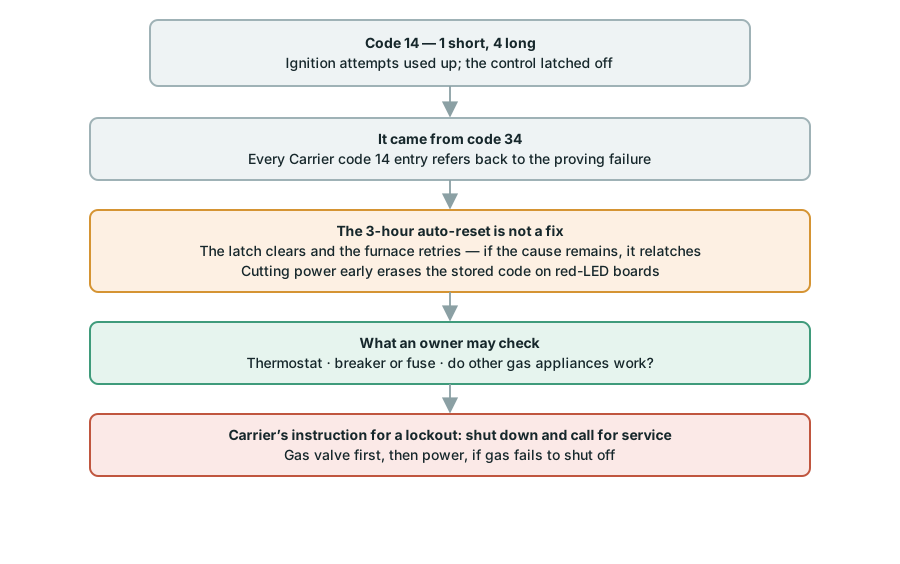
It means the ignition control has stopped trying. The furnace ran its full sequence — purge, ignite, look for a flame signal — the documented number of times, got nothing back each time, and latched. The burners are off and the gas valve is closed. Carrier documents the same three-hour auto-reset on every family where code 14 appears.
Two of Carrier's phrasings sit side by side in the literature, and they say the same thing at different levels of detail.
| Furnace family | Carrier's documented wording | Source |
|---|---|---|
| 58SC0A / 58SC1A | "System failed to ignite gas and prove flame in 4 attempts. Control will auto-reset after 3 hours. See status code 34." | 58SC0A-05SI, p. 37 |
| 58CVA / 58CVX | "Control will auto reset after 3 hours. Refer to status code #34." | TG-GFC80-02, p. 6 |
| 58SU0A Series 2 & 3 (Ultra-Low-NOx) | "Control will auto-reset after three hours. Refer to status code #34." | GFULN80-C-01TS, p. 6 |
Every entry sends you to code 34. That is because code 14 records the outcome while code 34 records the failure mode, and the diagnostic information a technician needs lives on the 34 side.
What does the three-hour auto-reset actually do?
It releases the lockout and lets the control run its ignition sequence again. That is the whole of it. The timer is a documented control behavior designed to retry after a long pause, on the reasonable assumption that some causes — a temporarily interrupted gas supply, for example — resolve on their own.
What it is not is a fix, and treating it as one is the mistake this code invites. If the cause is still present, the furnace burns through its attempts again and latches again. A house that gets brief warmth every three hours through a cold night is a house whose furnace is failing to light four times an hour, not a house with an intermittent problem that is sorting itself out.
Cutting power to force an earlier reset has the same shortcoming and one extra cost: on Carrier's red-LED boards, interrupting 115 V or 24 V power erases the stored status code, removing the record a technician would have started from.
What should an owner do when the furnace is locked out?
Confirm the things Carrier's owner's manual puts in an owner's hands, then stop. The manual's own framing is useful here — it describes this exact situation and names the response: if the main burners fail to ignite after four attempts the control will lock out, and "if lockout occurs, main burners fail to light, or blower does not come on, shut down the furnace and call your dealer for service" (90GSFRN-C-03OM, p. 6).
- Record the code. Note that it is 14 and not 34 — the difference tells the technician whether the furnace still had attempts left when you looked.
- Confirm the thermostat is calling for heat and set above room temperature, so you are not diagnosing a furnace that was never asked to run.
- Check the furnace breaker or fuse. This is on Carrier's own short list of things to verify before requesting a service call.
- Check whether your other gas appliances work. A whole-house gas interruption produces exactly this code and is not a furnace fault.
- Do not sit through repeated auto-reset cycles hoping it clears. Each cycle is another set of failed ignition attempts.
- Call. Carrier's instruction for a lockout is to shut the furnace down and call for service, and this page follows it.
Shutting the furnace down safely
If you are turning the furnace off before the technician arrives, Carrier's owner's manual gives an order for it: thermostat to its lowest setting, then close the external manual gas valve, then turn off the electrical supply. There is one ordering rule that matters more than the rest, and Carrier states it as a boxed warning: "Should the gas supply fail to shut off or if overheating occurs, shut off the gas valve to the furnace before shutting off electrical supply" (90GSFRN-C-03OM, p. 4).
Gas first, then power, in the abnormal case. Cutting electrical power to a furnace whose gas has not stopped removes the control that would close the valve.
When to call a technician
- Immediately. Code 14 is a lockout, and Carrier's owner-level instruction for a lockout is to shut down and call.
- Sooner still if the lockout repeats across several three-hour cycles, which means the cause is persistent.
- If you smell gas at any point, stop everything, leave the building, and call the gas utility or fire department from outside.
- If the furnace has been under water, do not run it at all — Carrier calls a flood-damaged furnace extremely dangerous and requires a qualified service agency to inspect it.
- If a CO alarm sounds, get outside, call 911, and do not go back in until responders say it is safe.
CPSC recommends a yearly professional inspection of fuel-burning heating systems, which is also the visit where an ignition problem that has been building through a season usually gets caught.
Related Carrier codes
Code 14's other half is code 34, the ignition proving failure that precedes it, and every Carrier entry for code 14 cross-references it. The limit circuit has the same pairing in code 33 and code 13. The Carrier furnace error codes hub explains how to read the flashes and lists the codes that have no page of their own.
Frequently asked questions
How do I reset a Carrier furnace on code 14?
The control resets itself after three hours on every family that documents this code. There is no owner reset procedure, and forcing one by cutting power erases the stored code on some boards without changing why the furnace could not light.
Why does my furnace work for a while and then lock out again?
That is the auto-reset doing its job. Every three hours the control clears the latch and retries; if the cause is still present, the ignition attempts fail again and the furnace relatches. The pattern points to a persistent fault rather than an intermittent one.
Is Carrier code 14 dangerous?
The lockout itself is the furnace behaving safely — it stopped rather than continuing to open the gas valve without proving a flame. The underlying fault still needs diagnosis, and a house with no heat in freezing weather carries its own risks.
What is the difference between Carrier code 14 and code 34?
Code 34 is the ignition proving failure while retries remain; code 14 is the lockout once they are exhausted. Carrier's code 14 entries all refer back to 34, because that is where the documented causes are listed.
Can I keep using the furnace while I wait for a technician?
Carrier's instruction for a lockout is to shut the furnace down and call for service. If you need to leave it running for heat, do not force repeated resets, and stop entirely if you smell gas, see soot, or a CO alarm sounds.