Generac Error Code 2100: Overload Remove Load
Code 2100 is the one alarm most owners can fix themselves. Generac states the cause in a sentence — "load demand exceeds the generator's rated power capacity" — and publishes 2100 through 2103 as one condition with one procedure. Its owner steps, in order: review the connected loads and identify what is not critical, disconnect or switch off the non-essential ones, verify any load-management device is working, turn the generator's main line circuit breaker OFF, turn the utility main OFF, clear the alarm, let the engine warm up a minute or two, then close the generator breaker and the utility main and bring circuits back one at a time.
| Code | 2100 (OVERLOAD REMOVE LOAD) |
|---|---|
| Applies to | Guardian and Next Generation air-cooled standby, Evolution / Evolution 2.0 / Power Zone 200 controllers; covers 2100, 2102 and 2103 |
| Severity | Unit will not run |
| DIY | DIY-friendly — owner can resolve it with the manual |
| Last checked |
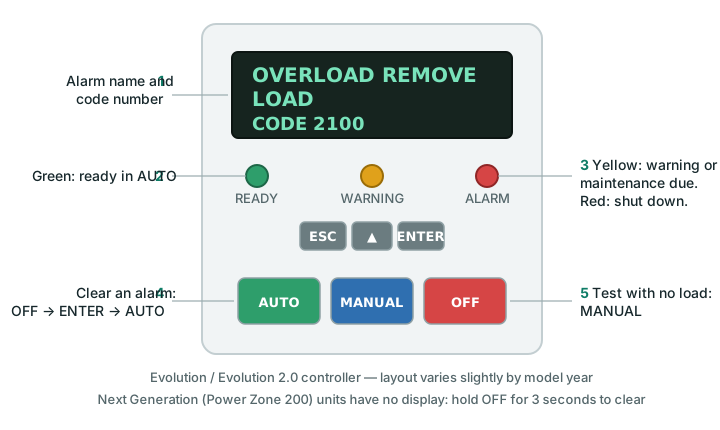
What code 2100 means
The controller compares the current the generator is delivering against what the machine is rated for. Sustain more than that and it posts OVERLOAD REMOVE LOAD, lights the red LED and stops the engine. Unlike 1600 Underspeed, which catches an overload by watching the engine slow down, 2100 is about the load itself — so it can fire while the engine is still holding speed.
Generac puts the cause in one sentence: "load demand exceeds the generator's rated power capacity." The usual way that happens is not one huge appliance but a stack of ordinary ones plus a motor start: the central AC compressor drawing several times its running current for a second while the well pump, dryer and water heater are already on. The other way is a load-shed arrangement that should have held the AC off and didn't, which is why Generac asks you to check that it is working before you touch anything else.
| Code | Display | Meaning (Generac wording) | Severity | DIY? |
|---|---|---|---|---|
| 2100–2103 | OVERLOAD REMOVE LOAD | "Load demand exceeds the generator's rated power capacity." Generac publishes one definition, one owner procedure and one Mobile Link message for all four numbers | Unit will not run | DIY-friendly |
The Mobile Link message for 2100–2103 is "The generator has experienced an overload alarm. Please contact a dealer," and Generac's code list classes the range as a red alarm. The number itself carries no separate instruction: if your panel shows 2102 or 2103 rather than 2100, the procedure below is still the whole of it.
How to clear Generac code 2100
2100 clears once the load comes off, and the order matters: take non-essential loads off, open the generator's main line circuit breaker and the utility main, then clear the alarm. After a one- to two-minute warm-up, close the generator breaker, then the utility main. If it trips again, Generac's first answer is still the load. Key presses per controller: Generac lights and alarms.
Generac's overload article (Dec 8, 2025), in its order:
- Review the loads connected to the generator. "Identify loads that are not critical during an outage."
- Disconnect or deactivate non-essential loads — "by unplugging non-essential loads or turning off connected breakers in the main electrical panel." The remaining loads, running together, should be "below the generator's rated power capacity."
- Load management. "If using a Generac Load Manager, verify it is functioning correctly, and lockouts are properly configured."
- Generator MLCB OFF, then utility main OFF. "Never attempt to start the generator while under load."
- Clear the alarm.
- Warm up, then restore. "Allow the engine to warm up for one to two minutes," turn the generator's MLCB ON, then the utility main ON "so that the generator will recognize when utility power is restored."
The owner's manuals put it in one row, OVERLOAD REMOVE LOAD: "Clear alarm and remove household loads from generator. Put in AUTO and restart." (Guardian A0001846499 Rev. C, p. 34; the Next Generation row on p. 37 reads "Put back in AUTO and restart."). If it trips again, the article's answer is the load first: "If the generator shuts down again with the same error code, it is still being overloaded. Repeat the process described above." And: "If the same alarm reappears after putting the generator in AUTO mode, remove additional loads or contact a Generac authorized service dealer."
Finding the load behind an overload
- Add it up. List what was on at the moment of the trip and run it through the wattage calculator, which adds starting surge for the largest motor. If the calculator's peak exceeds the generator's rating, the generator did what Generac describes: "Load demand exceeds the generator's rated power capacity."
- Find the big loads. Central AC, heat pump, well pump, pool pump: turn those breakers off, restart, and watch whether it holds. Generac's underspeed article notes that startup wattage "can be 3-4 times higher" than running wattage.
- Check load management. If the installer fitted AC shedding, it should hold the compressor off when the generator is loaded and release it when there's room. If the AC started immediately after transfer with everything else on, the shed module or its wiring is not doing its job — that's the installer's warranty call, not yours.
- Restart with the MLCB open, as Generac's outage article insists: "Starting your generator with all loads applied can cause damage to the generator." Bring circuits back in order of importance: refrigerator, furnace or boiler, well pump, lights, then the big ones.
- The number is 2101, 2102 or 2103. Generac gives no separate definition for any of them and no separate action — same condition, same procedure. Write the number down for the dealer and work the load review above.
- It trips with almost nothing on. Then it is no longer an owner question: Generac's article ends with "If issues persist after performing the checks and attempting to restart, contact a Generac IASD for diagnosis."
When an overload is a dealer call
- 2100 trips with light load after the branch-by-branch test above.
- Any of 2100–2103 still trips after the branch-by-branch test — the measurement that follows is not owner work.
- Load-shed hardware is fitted but the AC starts under full load anyway — installer.
- A single branch circuit trips the generator every time — licensed electrician for the house wiring.
- Generac support: 1-888-436-3722.
Load-related codes besides 2100
1600 Underspeed names the same load among its causes: "The unit is overloaded or has fuel supply issues." 1501 RPM sense loss while running is another, and Generac's RPM article lists "overload condition" and "sudden load change" among its causes. The owner's manuals also list LOW VOLTS REMOVE LOAD, with the same solution as an overload: "Clear alarm and remove household loads from generator." Portable-generator owners running the house through an interlock kit have no controller alarm; the generator's own breaker trips instead. Status lights and the clear sequence for every controller: lights and alarms.
Not sure the generator can carry the load?Generator Wattage Calculator Running watts, the largest starting surge, and a generator class from manufacturer charts.Frequently asked questions
What does Generac code 2100 mean?
Load demand exceeded what the generator is rated to deliver, so it shut down to protect itself. Generac's action is to remove load: turn off non-essential breakers, clear the alarm, restart with the main breaker open, and bring circuits back one at a time.
How do I reset a Generac overload alarm?
Turn off non-essential loads, set the generator's main breaker and the utility main to OFF, clear the alarm at the panel, and put it back in AUTO; the key presses for your controller are on the lights and alarms page. Once it has warmed up, close the generator breaker, then the utility main, and bring loads back one at a time.
Why does my Generac overload only when the air conditioner starts?
Compressor starting current is several times its running current. A soft-start kit on the AC or a load-shed module from the installer lets the generator carry it; the wattage calculator shows how close to the limit you are.
What is the difference between Generac 2100 and 2103?
Nothing that Generac publishes for owners. Its overload article covers 2100–2103 as one condition with one procedure, and its code list gives the range one entry and one message. The number is a detail for the dealer; the load review is the same either way.
Do I need a dealer for code 2100?
Usually not. Generac's article only sends you to a dealer if the alarm returns after loads are removed and the unit is back in AUTO.