Generac Code 1501: RPM Loss While Running and How to Clear It
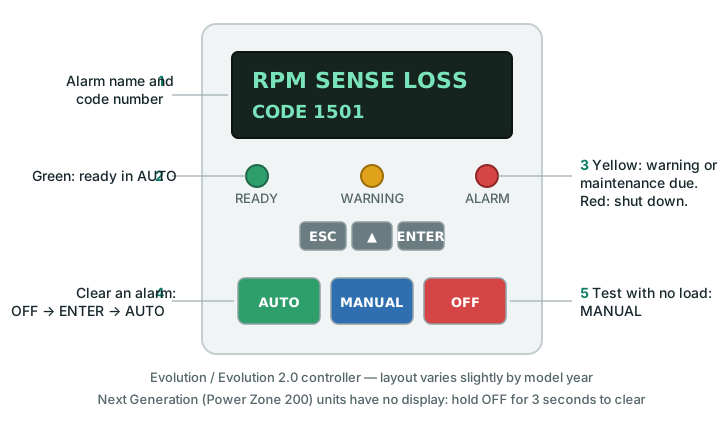
Code 1501 means the controller lost a valid engine RPM signal while the generator was running. Generac's support article covers codes 1500 through 1522 together and states that "end-user troubleshooting remains the same regardless of the error code." What separates your situation from a 1505 is not the number but the event: the unit started, carried the house for a while, and then shut itself down. The owner's manual has one instruction for that case — clear the alarm, take the household loads off the generator, put it in AUTO and restart. For a running shutdown, Generac's article names the checks to make before that: an overload or a sudden load change, load management, the fuel selection, the LP level, the air filter and maintenance status. It also says that in this case "a weak battery or bad connection is likely not the cause." If it will not restart, or shuts down again, Generac's instruction is an Independent Authorized Service Dealer.
| Code | 1501 (RPM SENSE LOSS) |
|---|---|
| Applies to | Air-cooled home standby: Guardian (Evolution and Evolution 2.0) and Next Generation (Power Zone 200) — Generac treats codes 1500–1522 as one RPM-sensor family |
| Severity | Unit will not run |
| DIY | Check, then call — owner-level checks first, then a dealer |
| Last checked |
What code 1501 means
Generac defines the whole family in one sentence: "The controller does not detect a valid RPM signal during startup or has lost a valid RPM signal while running." Codes 1500 through 1522 all show RPM SENSE LOSS on the display, and the Mobile Link message for the family reads "The generator has experienced a no crank RPM Sensor alarm. Please contact a dealer" — the same text whether the signal was lost cranking or running.
Generac does not publish, in any owner-facing document, what distinguishes 1501 from 1505, 1511 or 1515. Those distinctions exist in dealer service literature, which is not public and which this site does not cite. What the owner's manual does distinguish is the situation, and it gives a different instruction for each: one for RPM SENSE LOSS during cranking, and one for RPM SENSE LOSS on a unit that was running and shut down. You already know which happened, and that is what decides your next step.
| Code family | Display | Meaning (Generac wording) | Severity | DIY? |
|---|---|---|---|---|
| 1500–1522 | RPM SENSE LOSS | "The controller does not detect a valid RPM signal during startup or has lost a valid RPM signal while running" | Unit will not run | Check, then call |
Why a running shutdown points at load first
Generac's own owner-check list for this family includes assessing whether there was an overload condition or a sudden load change, and verifying that load management is working. That check belongs to a running shutdown far more than to a failure to start: a unit that carried the house until the air conditioner or the well pump kicked in, and then quit, is describing its own problem.
That is a sizing and load-management question, not a repair. The generator wattage calculator adds up what the circuits on the generator actually draw and shows the single largest starting surge among them, which is the figure a sudden-load shutdown turns on. If the total is at or over the unit's rating, no part replacement will fix it — the answer is load management, a soft-start on the largest motor, or a larger generator.
How to clear Generac code 1501
Take the household loads off before you clear a 1501. That is the owner's manual's instruction for RPM SENSE LOSS on a unit that was running and shut down: clear the alarm, remove household loads, put it back in AUTO and restart. If it will not start, the manual says contact a dealer. Controller-by-controller key presses are on Generac lights and alarms.
The Guardian manual's entry (A0001846499 Rev. C, Quick Reference Guide, p. 34):
Clear alarm and remove household loads from generator. Put into AUTO and restart. If generator does not start, contact an IASD.
The Next Generation manual (A0004332577 Rev. C, p. 37) gives the same row, worded "Put back in AUTO and restart." The other RPM SENSE LOSS entry, for a unit that failed while cranking, sends you to the BATTERY menu instead; that case is on the 1505 page.
Generac's RPM article is specific about the load step: "remove non-essential loads and attempt to start and run the unit with no load to verify if the issue may be load related," then "Identify and prioritize critical loads, then gradually add others to isolate any problematic loads." Its outage-restart article warns that "Starting your generator with all loads applied can cause damage to the generator." If 1501 returns after that, Generac's answer is a dealer, not a third reset.
Owner checks for a running shutdown
- Load. Was a large motor starting when it quit? Shed the big loads before restarting, and check that any load-management module is working. Generac lists an overload condition, a sudden load change and load management among the owner checks for this family.
- Fuel type selection. Natural gas or liquid propane, matching what the unit is actually connected to; Generac adds that on a unit not recently installed "it is unlikely that these settings are incorrect."
- Propane level. Generac: "When LP levels drop below 30%, fuel pressure may be affected, which can trigger an RPM sense loss alarm." On natural gas, ask the utility about supply problems during a large outage.
- Air filter. Clean and installed — see the maintenance kit page for the filter your model takes.
- Maintenance status. Generac asks whether scheduled service is current.
- Not the battery, usually. For this case Generac writes that "a weak battery or bad connection is likely not the cause." The battery check belongs to the failure-to-start case on 1505.
- Clear the alarm and restart unloaded. If it runs, return it to AUTO and bring the loads back gradually. If it does not, or 1501 returns, contact an Independent Authorized Service Dealer.
That list is complete. Generac states that fuel pressure and fuel quality checks must be performed by a professional, and it gives owners no procedure for the ignition system, the starter or the engine itself. Judging a fault by how the engine sounds, opening the enclosure to inspect coils or plug wires, and handling harness connectors are not Generac owner procedures and are not published here.
Filters and plugs on a 1501 unit
| Part | Part number | Fits | Where verified |
|---|---|---|---|
| Spark plug, RC12YC equivalent | 0G0767A | 14–26 kW (two per engine) | Owner's manual A0001846499 |
| Air filter | 0J8478S | 14–26 kW | Owner's manual A0001846499 |
| Air filter | 0E9371AS | 10 kW | Owner's manual A0001846499 |
| Control panel fuse, 7.5 A | 0D7178T | 10–24 kW | Owner's manual A0000973303 |
The air filter is the row an owner checks for this code; the plugs belong to the scheduled service Generac asks you to confirm is current. Ignition coils are engine-specific and Generac publishes no owner-facing part number for them. The battery is listed on the 1505 page, because Generac ties it to the failure-to-start case.
When a running shutdown needs a dealer
- 1501 returns after the loads are shed and the fuel and filter checks are clean.
- The unit will not restart at all after the reset — the manual's own instruction at that point is an IASD.
- Fuel pressure or fuel quality is suspect; Generac states those checks are professional work.
- 1501 appears with 1600 (underspeed) or 2100 (overload) in the same log — the same load question, confirmed twice.
- Generac support: 1-888-436-3722; warranty work goes through an Independent Authorized Service Dealer.
How 1501 differs from 1505, 1600 and 2100
1505 is the same family reported on a unit that failed while cranking rather than while running — the manual sends that case to the BATTERY menu instead: Generac 1505. 1600 Underspeed and 2100 Overload share the load question: Generac gives 1600's cause as "The unit is overloaded or has fuel supply issues" and 2100's as "Load demand exceeds the generator's rated power capacity." If the unit cranked and never started, that is 1100 Overcrank; if it did not crank at all and shows no code, see Generac won't start. Every code: Generac error codes. What each light on the unit means: Generac lights and alarms.
Not sure the generator can carry the load?Generator Wattage Calculator Running watts, the largest starting surge, and a generator class from manufacturer charts.Frequently asked questions
What is the difference between Generac 1501 and 1505?
Generac's owner-facing documentation does not distinguish them: its support article covers 1500–1522 together and says end-user troubleshooting is the same for every code in the family. The owner's manual distinguishes only the situation — RPM SENSE LOSS while running versus during cranking — and gives a different instruction for each. A running shutdown sends you to the loads; a cranking failure sends you to the battery.
My generator ran for twenty minutes and then stopped. Is that this code?
If the display shows RPM SENSE LOSS with a 1500-series number, yes. Generac's instruction for that case is to clear the alarm, take the household loads off the generator, put it in AUTO and restart. If it will not start, contact a dealer.
What does Generac code 1518 mean?
Generac publishes no individual definition for 1518, or for any other single number in the range. It falls inside the 1500–1522 RPM-sensor family, and the family's owner procedure is the one above.
Does a low battery cause 1501?
Not usually, according to Generac. Its RPM article says that if the unit runs and then shuts down with RPM sensor loss, "a weak battery or bad connection is likely not the cause"; it points to load, fuel and the air filter instead. The battery check is for a unit that failed to start, which is the 1505 case.
How do I reset a Generac 1501 alarm?
Shed the large loads first, then clear the alarm at the panel and restart in AUTO with nothing connected; the key presses differ by controller and are on Generac lights and alarms. If the code comes back, Generac says to contact a dealer rather than clear it again.