Generac Code 1505: RPM Sense Loss and How to Clear It
1505 means the controller is not seeing a valid engine RPM signal. Generac's support article covers codes 1500 through 1522 as one family and says so directly: "End-user troubleshooting remains the same regardless of the error code." The owner's manual gives one owner-level action for RPM SENSE LOSS during cranking — clear the alarm, open the BATTERY menu, replace the battery if it says CHECK BATTERY, and contact an Independent Authorized Service Dealer if it says GOOD. Before that call, Generac's article lists what you may check yourself: battery health and cables, the fuel shutoff valve, the fuel-type selection, propane level, the air filter, and whether maintenance is current. Then clear the alarm and try a manual start with no load. That is the whole owner procedure; anything past it is dealer work.
| Code | 1505 (RPM SENSE LOSS) |
|---|---|
| Applies to | Air-cooled home standby: Guardian (Evolution and Evolution 2.0 controllers) and Next Generation (Power Zone 200) — Generac treats codes 1500–1522 as one RPM-sensor family |
| Severity | Unit will not run |
| DIY | Check, then call — owner-level checks first, then a dealer |
| Last checked |
How to clear Generac code 1505
1505 clears at the panel, and what you do next depends on whether the unit failed to start or was running and stopped. For a failed start, the manual's test is the BATTERY menu: CHECK BATTERY means replace it, GOOD means call a dealer. Clear it with no household load connected; the button sequence for your controller is under clearing a Generac alarm.
What the manual says to do once it is cleared
Both owner's manuals list RPM SENSE LOSS twice in the Quick Reference Guide, and which row applies depends on what the unit was doing. If it would not start, the Guardian manual (p. 34) says:
Clear alarm. Using control panel, check battery by navigating to BATTERY MENU option from MAIN MENU. If battery condition displays GOOD, contact an IASD. If control panel displays CHECK BATTERY, replace battery.
The Next Generation manual (p. 37), for a controller with no display: "Check battery condition in Mobile Link or Field Pro app. Contact an IASD if battery condition shows good."
If it was running and shut down, the Guardian manual (p. 34):
Clear alarm and remove household loads from generator. Put into AUTO and restart. If generator does not start, contact an IASD.
The Next Generation row (p. 37) is the same except that it reads "Put back in AUTO and restart."
If 1505 won't clear, or comes back
Generac's RPM sense article: "If issues persist after performing the checks and attempting to restart, contact a Generac IASD for diagnosis." Its warning for the restart: "Never start a generator while under load." The checks it means are listed further down, under what Generac says you may check yourself.
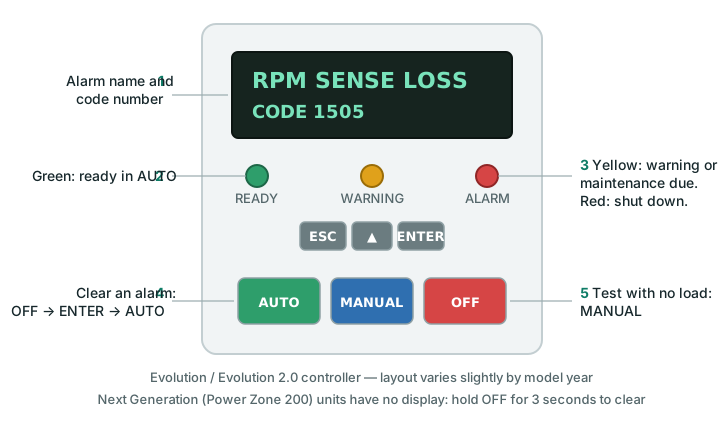
What code 1505 means
Generac's support article defines the whole family in one sentence: "The controller does not detect a valid RPM signal during startup or has lost a valid RPM signal while running." Codes 1500 through 1522 all carry the display name RPM SENSE LOSS, and the Mobile Link message for the family reads "The generator has experienced a no crank RPM Sensor alarm. Please contact a dealer."
Generac does not publish, in any owner-facing document, what distinguishes 1505 from its neighbors 1501, 1511 and 1515. Those distinctions exist in Generac's dealer service literature, which is not public and which this site does not cite. What the owner's manual does distinguish is the situation: it gives one instruction for RPM SENSE LOSS that occurred during cranking and a different one for RPM SENSE LOSS that occurred while running. You know which happened — the unit either never started, or it started and then stopped — and that, not the number, decides what you do next.
| Code family | Display | Meaning (Generac wording) | Severity | DIY? |
|---|---|---|---|---|
| 1500–1522 | RPM SENSE LOSS | "The controller does not detect a valid RPM signal during startup or has lost a valid RPM signal while running" | Unit will not run | Check, then call |
Owner checks Generac lists for RPM sense loss
- BATTERY menu. MAIN MENU → BATTERY. CHECK BATTERY means replace it — see Generac battery replacement for the specification your model takes. GOOD means the manual's next step is the dealer; the items below are the ones Generac's article still lists as owner checks before that call.
- Battery cables. Generac's routine battery-maintenance article asks owners to keep terminals clean and connections tight, and to check the state of charge. A corroded or loose terminal is something you can see with the unit OFF; cleaning it is within Generac's own maintenance guidance.
- Fuel shutoff valve. Open. This is the first fuel item in Generac's list.
- Fuel type selection. Natural gas or liquid propane, matching what the unit is connected to.
- Propane level. Generac's article names 30 % as the level below which an LP unit may not start.
- Air filter. Clean, and installed.
- Maintenance schedule. Generac's article asks whether the unit is current on scheduled service — see the maintenance kit page for what that schedule contains.
- Clear the alarm and press MANUAL with no household load on the generator. If it starts and runs, put it back in AUTO. If it does not, or the code returns, Generac's instruction is to contact an Independent Authorized Service Dealer.
That list is complete. It does not include listening to the engine, opening the enclosure to inspect the starter or ignition coils, or forcing an automatic transfer by cutting utility power — none of those are Generac owner procedures, and the starter and ignition system are where the dealer's diagnosis begins.
Battery and filter numbers behind a 1505
| Part | Part number | Fits | Where verified |
|---|---|---|---|
| Battery, Group 26R, 540 CCA (or Group 35 AGM 650 CCA) | 0H3421S | 10–26 kW air-cooled Guardian | Owner's manuals A0001846499 / A0000973303 |
| Air filter | 0J8478S | 14–26 kW | Owner's manual A0001846499 |
| Control panel fuse | 0D7178T | 10–24 kW | Owner's manual A0000973303 |
The battery row is the only one an owner acts on for this code. Starter motors and ignition coils are engine-specific and Generac publishes no owner-facing part number for them; the dealer pulls the right one from your serial number. Match the battery to your unit's generation, not to a kilowatt range — the Next Generation line takes a different battery from the Guardian, and the battery page keeps that scope.
When RPM sense loss needs a dealer
- BATTERY menu says GOOD and 1505 returns — this is the manual's own instruction.
- The code returns after a battery replacement.
- Cranking is slow or uneven with a charged battery and clean terminals.
- 1505 appears with 1100 (overcrank) or 2770/2780 (charger) in the alarm log.
- Generac support: 1-888-436-3722; warranty work goes through an Independent Authorized Service Dealer.
Codes and symptoms near 1505
1100 Overcrank is the code you see when the engine cranks its full cycle and never starts; it and 1505 often appear together on a unit with a weak battery. If the display is dark rather than showing a code, that is the control panel fuse or the battery, not this family — see Generac won't start. If the unit will not respond at all and the shutdown switch has been touched, see 2800. Every code, with its reset: Generac error codes.
Not sure the generator can carry the load?Generator Wattage Calculator Running watts, the largest starting surge, and a generator class from manufacturer charts.Frequently asked questions
What is the difference between 1505 and 1501, 1511 or 1515?
Generac's owner-facing documentation does not distinguish them. Its support article covers 1500–1522 together and states that owner troubleshooting is the same for every code in the family. The owner's manual distinguishes only by situation — RPM SENSE LOSS during cranking versus while running — and gives a different instruction for each.
My battery reads GOOD. What now?
The manual's instruction is to contact an Independent Authorized Service Dealer. Before that call, Generac's article lists the checks you may do yourself: cables, fuel valve, fuel type, propane level, air filter and maintenance status, then a manual start with no load.
Can a fairly new battery cause this code?
Generac's procedure treats the BATTERY menu reading as the deciding test, not the battery's age. If it reads CHECK BATTERY, replace it regardless of how old it is. Generac's maintenance guidance also covers checking the state of charge with a meter.
Does 1505 mean the RPM sensor needs replacing?
Generac's owner documentation does not name a replaceable RPM sensor for air-cooled units and does not give owners a part to replace for this code beyond the battery. What the controller is missing is the engine signal; why it is missing is the dealer's diagnosis.
Will Mobile Link show me 1505?
Yes — the status history shows the code, and the alert text reads "The generator has experienced a no crank RPM Sensor alarm. Please contact a dealer."
Parts and consumables
As an Amazon Associate we earn from qualifying purchases. Links open Amazon in a new tab; prices and availability are shown there, never here.
The battery is the one part Generac's procedure puts in the owner's hands; the specification for your generation is on the battery page.
- Generac 0H3421S Group 26R battery (540 CCA)Find on Amazon
- Battery terminal cleaning brushFind on Amazon