Generac Generator Runs but the House Has No Power
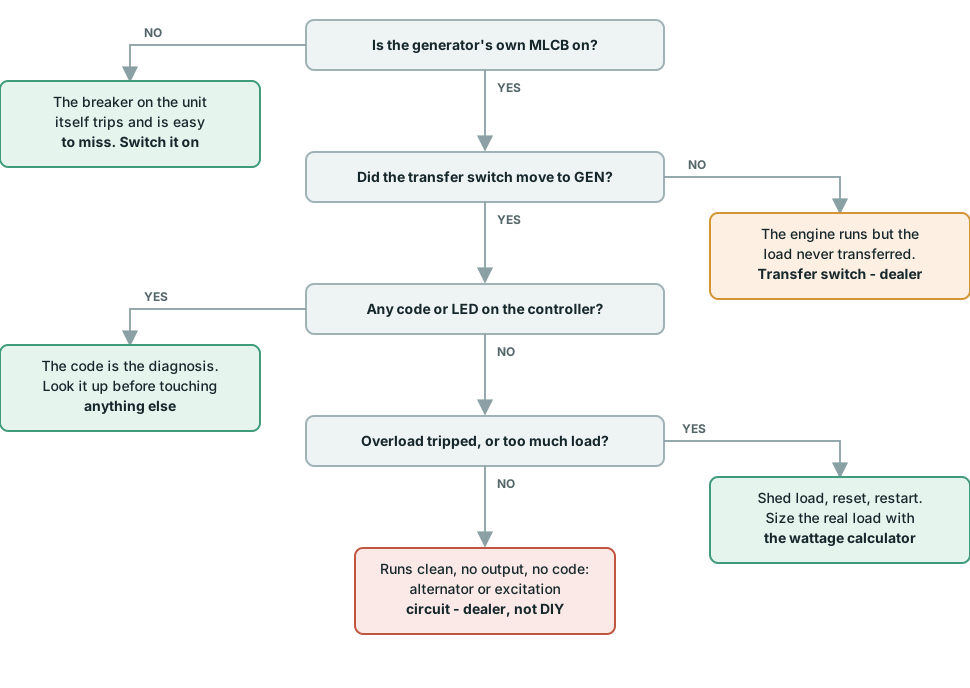
If the engine is running and the house is dark, the generator did its job — the transfer switch didn't do its part. Generac's support article says it in one sentence: the automatic transfer switch needs "voltage available from the generator and voltage on the transfer circuit (194/23 wires)"; if either is missing, no transfer. Owner checks, in Generac's order: the generator's main line circuit breaker (MLCB) is ON — with it OFF "the generator will start, but the ATS will not transfer power because it needs generator power to move to the standby position"; the warm-up delay has passed (the controller transfers when warm-up expires); the utility is actually out and the service disconnect after the meter is ON; and the display shows no alarm (an undervoltage or overload code means the generator stopped making usable power). Past that — the 194/23 wiring, the switch's fuses, the switch coil — Generac's line is that "untrained end users" should not service it. In an emergency, the owner's manual describes a manual transfer.
| Symptom | Generac Generator Runs but the House Has No Power |
|---|---|
| Applies to | Guardian and Next Generation air-cooled home standby with RTS / HomeLink automatic transfer switches; a section on portable generators at the end |
| Severity | Unit will not run |
| DIY | Check, then call — owner-level checks first, then a dealer |
| Last checked |
Most likely causes, in order
| Cause | How to confirm | Fix | DIY? |
|---|---|---|---|
| Generator MLCB OFF | Breaker under the lid (Guardian 2016+) or in the side compartment (older) is at OFF; engine runs, nothing transfers | Set MLCB ON. Generac: "Do NOT leave the generator MLCB locked in the OFF position during normal generator operation" | DIY-friendly |
| Warm-up delay not finished | Display reads WARMING UP; house comes on after a short wait | Wait. Default startup delay is a few seconds; after an undervoltage it's four minutes | DIY-friendly |
| Utility not actually out | Green LED, "Ready to Run"; neighbor has power; your main breaker is tripped | The generator won't transfer while it senses utility on N1/N2. Reset your own main; if the meter is dead, call the utility | DIY-friendly |
| Generator stopped making power | Red LED with 1900-series, 1600 or 2100 code; engine may still be spinning down | Go to the code page; shed loads and clear per its instructions | Check, then call |
| 194/23 transfer circuit | TRANSFER WIRE WARN on the display, or a 2098/2099 wiring error; or nothing at all and the switch never clicks | Dealer. 194 carries 12 V DC to the switch coil; 23 is its signal ground | Licensed pro / dealer |
| Transfer-switch fuse or coil | Engine runs, MLCB ON, no alarm, switch silent; no house-side voltage | Dealer — the switch's fuses and coil sit next to live utility conductors | Licensed pro / dealer |
The owner's manual's troubleshooting row for "no transfer to standby after utility source failure" lists the same suspects in the same order: generator MLCB off, faulty transfer switch coil, faulty transfer relay, transfer relay circuit open, faulty control logic board, engine warming up. The remedy column says "set MLCB to ON (closed)" for the first, "check controller screen to verify status" for the last, and "contact an IASD" for everything in between. That's an honest map of what an owner can and can't do here.
Check these first (five minutes)
- Open the lid. Find the MLCB. Generac's MLCB article: on Next Generation units it's upper-right under the lid; on 2016-and-later Guardians under the lid; on older air-cooled units in the side-panel compartment. It should read ON. Technicians switch it off for service and forget; owners lock it off for a vacation and forget. If it's off, turn it on — the switch should transfer within seconds.
- Read the display. WARMING UP — wait. A red LED and a number — the generator has shut down or is about to, and the number is the diagnosis: 1900 Undervoltage, 1600 Underspeed or 2100 Overload all mean the house was too much for it. TRANSFER WIRE WARN — the 194/23 circuit, dealer.
- Is the utility really out? Look at the LED: green with "Ready to Run" means the controller sees utility voltage on N1/N2 and will not transfer. Check your own main breaker at the panel — a tripped 200 A main looks exactly like an outage from the kitchen — and the service disconnect by the meter. Ask a neighbor.
- Did the switch click? Stand by the transfer switch when the generator reaches speed. An RTS or HomeLink switch makes an audible clunk as the contacts move. Silence with the engine running and the MLCB on says the coil didn't get its 12 V — the 194/23 circuit or a fuse.
- Confirm generator voltage — from a distance. If the unit is enrolled in Mobile Link, the app shows output voltage. Don't open the connection panel with the unit running.
- Stop here if it's the switch. Generac's ATS article: "Generac does NOT recommend untrained end users attempt to modify or service internal generator wiring." The utility side of the switch is live at 240 V whenever the grid is up. The switch's three fuses, the coil, and the control wires are the technician's next ten minutes.
The transfer circuit, in plain terms
Six small wires run from the generator's customer-connection strip to the transfer switch. Generac's article names the two that matter here: 194 "provides 12 VDC to the ATS and is always powered," and 23 "is the signal ground side of the transfer circuit and is controlled by the generator control panel." When the controller decides to transfer, it completes the 23 side; the switch coil sees 12 V across 194 and 23 and pulls the contacts over to STANDBY. Break either wire, blow the fuse that protects them, or lose 12 V on 194, and the switch stays on UTILITY while the generator hums in the yard.
The other wires — N1 and N2 (utility sensing) and T1 (charger feed) — cause different symptoms. A crossed N1 or N2 posts a 2098/2099 wiring error rather than a silent no-transfer. A dead T1 posts 2780 and lets the battery run down.
Manual transfer in an emergency
The owner's manual gives a procedure for moving the switch by hand, and it's worth knowing before you need it. To generator: verify the unit is OFF → generator MLCB OFF → turn off the utility supply to the transfer switch → move the contacts to STANDBY with the manual transfer handle inside the switch → press MANUAL → let it warm up a few minutes → MLCB ON. To return: MLCB OFF → run one minute with no load → OFF → verify the utility supply to the switch is off → move the contacts to UTILITY with the handle → turn the utility supply on → AUTO → MLCB ON.
The 2017 manual states the rule that makes this safe: "Do not manually transfer under load. Disconnect transfer switch from all power sources prior to manual transfer." If "turn off the utility supply to the transfer switch" isn't something you can do with confidence at your own service equipment, don't open the switch — call, and run extension cords from the generator's own outlets to the refrigerator in the meantime, if it has them.
Portable generator runs but no power
Different machine, mostly different causes. In rough order of likelihood: the GFCI or breaker on the generator's panel tripped (press reset; if it trips again with nothing plugged in, the generator has a fault); the interlock or manual transfer switch in the house isn't thrown — with an interlock kit, the utility main must be OFF before the generator breaker can be turned ON, and the generator's own breaker must be on too; the inlet cord isn't fully seated and twisted to lock (L14-30 plugs need the twist); only one leg is live, so half the house works — a 120/240 V generator with its selector on 120 V, or a bad cord; and on brushed generators, the residual magnetism is gone after long storage, so the unit spins but makes no voltage — that's a repair-shop job, not something to "flash" with a drill at home. The interlock kit vs transfer switch guide covers the house side of this.
Repair or replace?
A no-transfer with the engine running is usually a fuse, a wire, or the MLCB — labor, not parts. A transfer-switch coil or a full switch replacement is a real cost, but the generator itself is unaffected; if the switch is a decade old and water-damaged, the technician's photo of the inside will make the decision for you. Nothing on this page argues for replacing the generator.
When to call a dealer
- Engine runs, MLCB ON, utility confirmed out, no alarm — and the switch never moves.
- TRANSFER WIRE WARN, 2098 or 2099 on the display.
- You can't confirm how to isolate the transfer switch from the utility for a manual transfer.
- The house comes on, then drops out repeatedly — the switch is chattering or the generator is faulting under load.
- Generac support: 1-888-436-3722.
Parts and consumables
As an Amazon Associate we earn from qualifying purchases. Links open Amazon in a new tab; prices and availability are shown there, never here.
A plug-in receptacle tester tells you in two seconds whether the house is getting generator voltage and on which leg; a non-contact tester confirms a panel is dead before anyone touches it.
- Non-contact AC voltage testerFind on Amazon
- Plug-in outlet voltage tester / receptacle testerFind on Amazon
Related pages
If the engine never started at all: Generac won't start. Every alarm the display can post: Generac error codes. Choosing between an interlock kit and a transfer switch for a portable? Start with the interlock vs. transfer switch guide. If you already know which route you need, use the Generator Interlock Kit Finder or the Manual Transfer Switch Finder.
Not sure the generator can carry the load?Generator Wattage Calculator Running watts, the largest starting surge, and a generator class from manufacturer charts.Frequently asked questions
Why does my Generac run but not power the house?
The transfer switch didn't transfer. Generac's first check is the generator's main line circuit breaker (MLCB) — with it OFF the engine starts but the switch has no generator voltage to move on. Then: warm-up delay, whether the utility is actually out, any alarm on the display, and the 194/23 transfer circuit (dealer).
What is the MLCB on a Generac?
The generator's main line circuit breaker, under the lid on 2016-and-later Guardians. Generac says it must be ON during normal operation; it's turned OFF for maintenance and lockout.
Can I transfer a Generac switch manually?
The owner's manual describes it: unit OFF, MLCB OFF, utility supply to the switch off, move the contacts with the handle inside the switch, then start in MANUAL and close the MLCB. Never transfer under load, and never with the switch connected to a live source. If you can't isolate it with confidence, call.
What do the 194 and 23 wires do?
Per Generac: 194 carries 12 V DC to the transfer switch and is always powered; 23 is the signal-ground side that the controller closes to command a transfer. If either is open, the switch stays on utility.
My portable generator runs but has no output. Why?
Most often a tripped GFCI or breaker on the generator's panel, a cord not twisted to lock, or a house-side interlock or transfer switch not thrown. A brushed generator that spins but makes no voltage after long storage has lost residual magnetism — a shop repair.